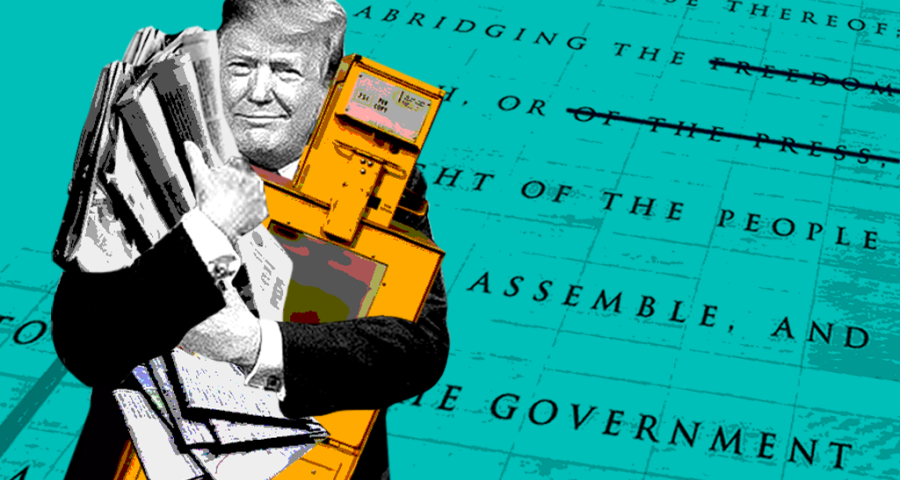
Trump with newspapers

Molly Butler / Media Matters

The year the media oligarchs bowed to Trump

We warned last year that Donald Trump’s second term as president would turbo-charge the political right’s burgeoning media-intimidation complex. Republican officials and right-wing billionaires were already trying to secure their political agenda by using their wealth, lawfare, and government power to silence journalists. And Trump, we wrote, using his authoritarian strategies, would force media moguls to choose between the journalistic integrity of the news outlets they oversee and their broader business interests, with the fate of the free press in the balance. 

Twelve months later, it is clear that many of these corporate media owners have made their choice: They are damaging celebrated news outlets like CBS and The Washington Post out of some combination of personal preference and political expedience. While journalists at their outlets are still producing important stories that reveal the corruption and malfeasance of the Trump administration, it’s anyone’s guess how long they will be permitted to do so.

Trump has spent the last decade at war with the press. He has no regard for free speech, treats all dissent as inherently illegitimate, and uses every available tool to curtail critical journalism. The president’s years of anti-media diatribes have achieved their goal of destroying the credibility of potentially damaging reporting among his supporters, and in his second term, he has backed up those verbal attacks with a flurry of actions. 

He and his administration have supplemented or even replaced members of the traditional press corps in favor of MAGA influencers and Trumpist outlets; defunded public media outlets in the U.S. and sought to dismantle them abroad; sued reporters and news outlets for publishing content he dislikes; and terminated rules protecting journalists from prosecutorial scrutiny, while targeting them with retaliatory immigration enforcement.

But Trump’s most unnerving assaults on the press involve his administration's use of state power as leverage against oligarchs who control broadcast and cable news operations and major newspapers. For billionaire owners or top executives at massive multimedia companies, news outlets typically represent a tiny fraction of their overall business interests. And those broader holdings create potential vulnerabilities — like regulatory scrutiny of mergers, federal contracting, and criminal investigations — that an authoritarian president can manipulate to encourage media moguls to cudgel their news outlets into line. 

Trump’s strategies resemble those of Victor Orban, the Hungarian autocrat many on the American right take as a model, who has dismantled his country’s independent press and forced the sales of outlets to his allies. Trump's desired result is a cowed journalist corps that will produce Fox News-style propaganda venerating his successes and covering up his corruption and failures.

America’s media oligarchs often resisted Trump’s corrupt abuses of power in his first term, either enduring his attacks without constraining their news outlets or beating his administration in federal court. But in his second term, while some media organizations (including Media Matters) have fought to protect the First Amendment against Trump and his administration, certain wealthy magnates have chosen the path of cowardice, submission, and collaboration

  • David and Larry Ellison

    David Ellison is the son of Larry Ellison, the Oracle co-founder who is one of the richest men alive and a close friend and ally to Trump. The younger Ellison took control of CBS News in July after the Federal Communications Commission approved his Skydance Media’s purchase of CBS parent company Paramount. Trump-appointed FCC Chair Brendan Carr acted only after Paramount agreed to pay $16 million to settle an absurd lawsuit Trump filed over CBS News’ editing of an October interview with then-Democratic presidential nominee Kamala Harris — and after he secured pledges from Skydance to push the network’s coverage to the right. 

    Ellison followed through on his promise. The new ownership appointed “anti-woke” champion Bari Weiss as CBS News’ editor-in-chief and Kenneth Weinstein, a Trump-supporting right-wing think tanker, as its ombudsman. An October wave of layoffs hit nearly 100 CBS News employees, gutting the network’s teams focused on climate change and race and culture. Trump certainly seems happy with the changes — in a November 2 interview that marked his first appearance on the network since 2020, he praised Weiss as a “great new leader” and “great person” and described David Ellison’s takeover of CBS News as “the greatest thing that’s happened in a long time to a free and open and good press.” 

    With the CBS News takeover as proof of concept, Ellison and his father are each making moves to seize additional media outlets and move them in a Trumpy direction. 

    David Ellison is trying to buy Warner Bros. Discovery — and the administration is reportedly signaling that other bidders will face grueling oversight from federal regulators. “Trump wants WBD in the Ellisons’ hands, and insiders say it’s because he wants favorable coverage from its CNN news channel,” wrote the New York Post. 

    Larry Ellison has even reportedly “engaged in a dialogue” with the White House “about possibly axing some of the CNN hosts whom Donald Trump is said to loathe, including Erin Burnett and Brianna Keilar,” if the sale were to go through. 

    The Trump White House is also trying to broker a deal in which the social media giant TikTok, a news source for one-fifth of American adults and 43% of those under 30, would be sold to a coalition including companies controlled by Larry Ellison as well as fellow pro-Trump magnate Marc Andreessen.

  • Jeff Bezos

    Bezos owns The Washington Post, but his massive fortune comes from founding Amazon, the online retailing and web service giant, and he also owns the space technology company Blue Origin. During Trump’s first term, Bezos bore numerous potshots at what Trump termed the “Amazon Washington Post,” as well as his administration’s apparent retaliation against Amazon’s operations. But Bezos signaled that things would be different in a second term even before Trump’s election when he barred the Post’s editorial board from endorsing in the 2024 contest, blocking the publication of its piece supporting Harris. 

    The decision began a deterioration of Bezos’ relationship with the Post, accelerated further by his February demand that the paper’s Opinion section advocate without exception for “personal liberties and free markets.” Opinion editor David Shipley resigned rather than execute that pivot; his replacement, Adam O’Neal, an undistinguished reporter and editor previously at The Economist and The Wall Street Journal, has overseen buyouts and layoffs of the section’s veterans (my wife Alyssa Rosenberg, the section’s former letters and community editor, was among those who took the buyout) and hired several conservative writers, leading one of the paper’s right-wing columnists to boast, “We’re now a conservative opinion page.” The dramatic changes seem to have blown a hole in the Post’s subscriber numbers, with NPR’s David Folkenflik estimating “a net loss of a couple hundred thousand subscribers” at the end of February. With revenue plummeting thanks to Bezos’ decisions and the owner unwilling to eat the losses, more layoffs are reportedly on the way.

    But defanging the Post — and finding a way to put money in the Trump family’s pockets — seems to be working out well for Bezos. His rewards include plum seats for Trump’s swearing-in, federal contracts for Blue Origin and Amazon Web Services, and the president publicly applauding him for “trying to do a real job with The Washington Post, and that wasn’t happening before.”

  • Patrick Soon-Shiong

    Like Bezos, Los Angeles Times owner Soon-Shiong has other business interests that left him vulnerable to Trump’s retaliation; he made his fortune in the biotech industry, and his medical patents and products are subject to federal oversight. Whether due to fear of retribution or a shift in his own political views, Soon-Shiong stepped up his oversight of the Times last year, beginning with the cancellation of a planned endorsement of Harris. 

    He subsequently shilled for Robert F. Kennedy Jr.’s confirmation as secretary of health and human services; announced a remaking of the editorial board, beginning with the addition of pro-Trump CNN commentator Scott Jennings; killed an editorial that criticized Trump’s Cabinet picks; announced the addition of an AI-powered “bias meter” to the paper’s opinion pieces, which was pulled after it downplayed the Ku Klux Klan; floated a conservative version of The View featuring right-wing actor Rob Schneider; launched “LA Times Studios,” a multimedia studio featuring influencers reading AI-generated scripts; sat for interviews with right-wing commentators including Tucker Carlson and Megyn Kelly; and put forward an ill-starred initial public offering plan which led The Hollywood Reporter to ask, “Does Patrick Soon-Shiong Want to Turn the L.A. Times Into a MAHA Memestock?”

    As with Bezos’ actions at the Post, Soon-Shiong’s changes to the Times have resulted in plummeting circulation, an exodus of talent, and the diminishment of the paper’s influence. But his medical patents are still getting approved by the federal government.

  • Bob Iger

    Iger, who as the CEO of Disney oversees its subsidiary ABC, was at the center of two of the most craven media moves since Trump’s reelection.

    First, his December 2024 decision to sign off on a $15 million “blood sacrifice to Trump,” settling a defamation lawsuit that ABC News’ lawyers thought they would win, only looks worse over time. The capitulation made clear to ABC staff that Iger would not support them in a stand-off with the president and set a precedent that media companies and other major corporations would knuckle under to his demands. 

    Second, after Carr threatened Disney and ABC’s affiliates with FCC retribution if they failed to “take actions” against Jimmy Kimmel over one of his monologues in September, Iger folded by suspending Kimmel’s show within hours. Carr’s threats made a mockery of the First Amendment — but Iger wasn’t willing to fight to uphold those rights in court. Iger relented and returned Kimmel to the airwaves only after an outcry by Hollywood talent and a spike in Disney+ cancellations.

    What did Iger’s cowardice bring ABC? When ABC News chief White House correspondent Mary Bruce dared to ask Saudi Crown Prince Mohammed bin Salman a question about his role in the brutal murder of the U.S.-based dissident journalist Jamal Khashoggi during a joint Oval Office appearance with Trump, the president became enraged, lashing out at the journalist and calling her outlet “fake news” and “one of the worst in the business.” 

    “I think the license should be taken away from ABC because your news is so fake and it’s so wrong,” he later added, threatening to shut down a U.S. news outlet for producing reporting he doesn’t like in front of a foreign dictator who represses his own country’s media

    “And we have a great commissioner, a chairman, who should look at that," he added.