
Fox News pretended that President Donald Trump and his tariffs had revived America’s manufacturing sector while Trump was on tour to defend his economic policies. But the most-recent data shows that manufacturing employment has declined by 72,000 since Trump announced his sweeping tariffs in April, and multiple industry surveys in recent months show a slowdown in manufacturing sector activity, with many manufacturers directly blaming the tariffs.
Research/Study
Fox pretends Trump and his tariffs have revived manufacturing, but reports show the US has lost 72,000 manufacturing jobs since April
Written by Zachary Pleat
Published
Select a section
-
Data shows a continued decline in manufacturing employment since April, and economists blame it on Trump’s tariffs
-
- BLS data shows job creation falling off a cliff after Trump’s April announcement of “Liberation Day” tariffs. After 158,000 jobs were created in April, a mere 19,000 were added in May, with job losses in June, August, and October. [Bureau of Labor Statistics, accessed, 1/9/26]
- Manufacturing-related construction spending peaked at the end of the Biden administration and has declined so far under Trump. [Federal Reserve Bank of St. Louis, accessed 1/21/26]
- Washington Post: “Manufacturing employment has declined every month since Trump dubbed ‘Liberation Day’ in April. … U.S. factories employ 12.7 million people today, 72,000 fewer than when Trump made his Rose Garden announcement.” The Post continued: “The trade measures that the president said would spur manufacturing have instead hampered it, according to most mainstream economists. That’s because roughly half of U.S. imports are ‘intermediate’ goods that American companies use to make finished products, like aluminum that is shaped into soup cans or circuit boards that are inserted into computers.” It added: “So while tariffs have protected American manufacturers such as steel mills from foreign competition, they have raised costs for many others. Auto and auto parts employment, for example, has dipped by about 20,000 jobs since April.” [The Washington Post, 1/15/26]
- University of Michigan economist Betsey Stevenson: “We are bleeding manufacturing and goods producing jobs, not *despite* the tariffs, but probably *because* of them given the ham-fisted approach to tariffs.” [Bluesky, 1/9/26]
- Moody’s Analytics chief economist Mark Zandi: “I’m increasingly convinced that the job market is struggling, and the broader economy is fragile, in big part due to U.S. tariffs.” Zandi added in subsequent posts: “There has been no job growth (and likely job declines after all the revisions are in), as measured by either the payroll or household employment data, since Liberation Day last April, following the President’s announcement of significant reciprocal tariffs. This reflects the direct effects of the tariffs on manufacturing, transportation and distribution, and ag-related businesses, which are steadily losing jobs, as well as the indirect uncertainty hit to hiring by most other businesses.” [Bluesky, 1/11/26, 1/11/26, 1/11/26]
- European Council on Foreign Relations geoeconomics expert Agathe Demarais: “Tariffs are not fuelling a US manufacturing revival.” Demarais continued: “Manufacturing sector created jobs for last time in March this year, ahead of Liberation Day. Since Trump's tariff salvoes, manufacturing firms slashed headcounts in each month, by around 70k people in total.” [Bluesky, 1/6/26]
- University of Michigan economist Justin Wolfers: “Tariffs are imposed on goods, not services, so let's check in on that breakdown. Since ‘Liberation Day’: Goods-producing sector has shed -90,000 jobs. Private services have added +391,000 jobs.” [Bluesky, 1/9/26]
- Center on Budget and Policy Priorities chief economist Gbenga Ajilore: Trump’s policies “have furthered” the manufacturing sector’s “struggle.” Ajilore continued: “In particular, the chaotic trade war has raised costs for manufacturers, making it difficult to increase revenue. This has translated into less hiring.” He concluded: “The bottom line is that the labor market continues to feel the effects of the administration’s harmful tariffs, and will continue to show weakness in 2026.” [Bluesky, 1/9/26]
- The Bulwark economics editor Catherine Rampell: “Manufacturing has been contracting for most of the past year. If you drill down you'll see metal manufacturing is doing ok, because Trump pummeled their competition with tariffs. Meanwhile the downstream US firms (machinery, electronics, autos) that have to *buy* more expensive metal are screwed.” [Bluesky, 1/9/26]
- Economic writer Joey Politano: “The US is losing blue-collar jobs for the first time since the early pandemic—year-on-year job losses have hit 145k as manufacturing, transportation, & mining industries lose jobs at a rapid pace while growth in construction has nearly zeroed out.” Politano added in his newsletter: “Tariffs are hurting blue-collar employment by raising the costs of manufacturing inputs. Immigration raids are disproportionately hurting the construction sector. Cuts to industrial policy subsidies have helped push factory construction down more than 8% over the last year. The administration’s desired ‘blue-collar boom’ is not happening; quite the opposite.” [Bluesky, 1/9/26; Apricitas Economics, 1/6/26]
-
Multiple recent surveys of manufacturers show decreased activity and complaints about Trump’s tariffs
-
In early 2025, as Trump began implementing his most sweeping tariff proposals, industry surveys already began to show manufacturers had concerns about the new import taxes harming their sector. Business owners warned that Trump's tariffs would make operations more difficult and expensive, while experts warned that tariffs would not result in Trump's promised increases in employment in the manufacturing sector. Now, one year into Trump’s second term, surveys of the manufacturing sector and new data on employment reveals a manufacturing downturn during the Trump administration.
- Respondents to the December 2025 Institute for Supply Management’s Purchasing Managers’ Index report complained that tariffs are hurting their manufacturing businesses. One chemical products manufacturer said: “It has not been a great year. We have had some success holding the line on costs; however, real consumer spending is down and tariffs are ultimately to blame.” A machinery manufacturer responded: “Trough conditions continue: depressed business activity, some seasonal but largely impacted by customer issues due to interest rates, tariffs,” and other issues. And an electrical equipment manufacturer said: “Morale is very low across manufacturing in general. The cost of living is very high, and component costs are increasing with folks citing tariffs and other price increases. … So, things look a bit bleak overall.” [Institute for Supply Management via PRNewswire, 1/5/26]
- The National Association of Manufacturers’ 2025 Q4 Manufacturers’ Outlook Survey reported that “trade uncertainties remained the top business challenge at 73.1%, with 80.3% of respondents reporting they have paid tariffs on imported manufacturing inputs since the start of the year.” The report also stated: “Tariffs are impacting manufacturers of all sizes, with 72.8% small and medium-sized manufacturers with less than 500 employees paying tariffs on inputs this year—alongside 97% of large manufacturers.” [National Association of Manufacturers, 12/17/25]
- The Federal Reserve Bank of Dallas reported on December 29: “Texas manufacturing activity dips.” One manufacturer commented: “Tariffs [remain a concern]. I feel like a broken record.” A printing manufacturer commented: “We have gotten stupid slow. … We will be shutting down the plant floor for multiple days due to lack of work. We have to believe this is a direct effect from the total lack of predictability coming from Washington and the ill-conceived idea of tariffs benefiting our economy.” [Federal Reserve Bank of Dallas, 12/29/25]
- The Federal Reserve Bank of Richmond reported: “Fifth District manufacturing activity remained slow in December, according to the most recent survey from the Federal Reserve Bank of Richmond.” [Federal Reserve Bank of Richmond, 12/23/25]
- CNBC’s latest survey with the Association for Supply Chain Management found that “rising costs associated with President Trump’s tariffs have resulted in increased layoffs and less capital for investments.” CNBC also reported that “65% of survey respondents reported at least a 10%-15% increase in their supply chain costs, and business tell CNBC that even if the Supreme Court rules IEEPA [International Emergency Economic Powers Act] tariffs illegal, refunds won’t recover many costs they have incurred.” [CNBC, 1/12/26]
- Bloomberg columnist and Cato Institute economist Scott Lincicome: “The harms to manufacturers are consistent with research on past tariff episodes and help to explain why the sector struggled in 2025 — and why things might not get much better this year. Recent forecasts also suggest caution, with manufacturers and supply chain professionals predicting continued headwinds due to the costs, uncertainty and complexity of tariffs.” Lincicome added: “Then there’s the Federal Reserve's Beige Book of regional economic conditions and surveys from the regional Fed banks, which have repeatedly documented cases of manufacturers delaying hiring and investment amid weak market conditions, rising costs, shrinking profit margins and persistent uncertainty. As for the ‘hard’ data, manufacturing capacity and output, while incomplete, sagged through the Fall.” [Bloomberg, 1/15/26]
-
Fox continues to pretend Trump and his tariffs are reviving American manufacturing
-
When Trump first announced his so-called “Liberation Day” tariffs in April 2025, which was described at the time as “the largest peacetime tax increase” in U.S. history, dozens of Fox News personalities eagerly threw their support behind his unprecedented intervention into American tax and trade policy. Even after the chaotic implementation of Trump’s tariff regime became more apparent and the administration scrambled to contain the damage by pausing many of them, Fox personalities were proclaiming that the tariffs would “reignite a manufacturing golden age.”
- After playing a clip in which Trump boasted about tariffs, Fox Business host Elizabeth MacDonald said that he “is the first president since Ronald Reagan to dramatically upgrade and reset the U.S. economy. He's moving it from a consumption-based big government spending economy, to one rooted in production and manufacturing, factories, making things.” [Fox Business, The Evening Edit, 1/14/26]
- Fox Business host Jackie DeAngelis: Trump “got so much out of these tariffs that wasn't even about the actual tariffs. The changes in manufacturing, incentivizing … companies [to come] to the United States and build on U.S. soil. Companies are already starting those manufacturing facilities this year.” [Fox Business, The Big Money Show, 1/14/26]
- Fox Business host Charles Payne claimed “there’s a certain type of optimism” about Trump’s tariffs from manufacturers: “The idea of reindustrializing our nation, it’s a win, win, win, win for everyone. It's ultimately a win for businesses. It's obviously a win for America and our economy. And also workers, all right? It's a win for national security. It's just a win on all fronts.” Payne continued: “And so now, particularly this year, you are going to see a boom. Expensing these investments, being able to write certain things off. Sort of the carrot and stick approach. The carrot is here. Go for it — businesses are.” Fox host Griff Jenkins then claimed “an American manufacturer” told him “he thinks there is a renaissance in manufacturing happening in this country,” which Payne agreed to. [Fox News, Fox & Friends, 1/14/26]
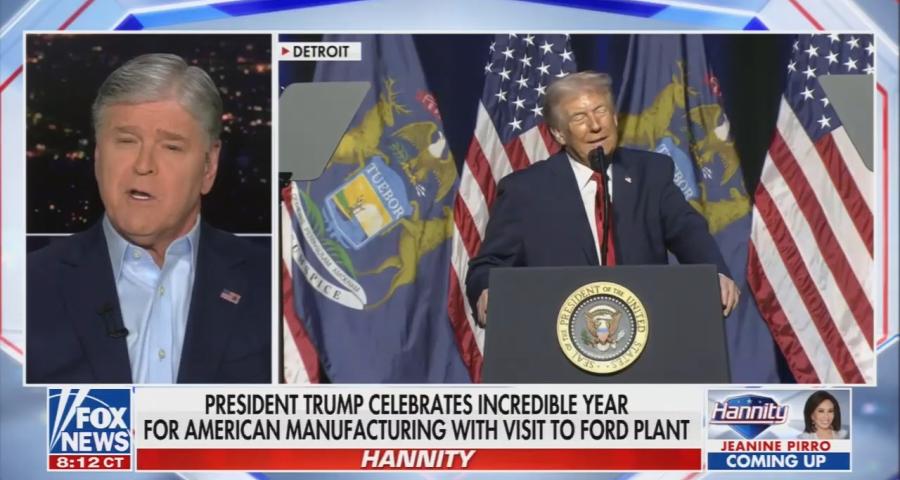
- Fox News host Sean Hannity: “Trump visited a Ford plant in Michigan to celebrate what has been an incredible year for American manufacturing.” Hannity continued: “Billions, and actually trillions, in committed manufacturing investment money.” [Fox News, Hannity, 1/13/26]
- Fox’s The Ingraham Angle promoted Trump’s auto industry tour with a graphic reading: “America 250: Manufacturing means strength.” Host Laura Ingraham said: “Once again, Donald Trump is carrying the entire Republican Party on his back. Their midterm strategy is here. America 250, strength is back in everything we do.” She continued: “U.S. manufacturing is key to this comeback. And there’s nowhere better to showcase this than the Motor City.” [Fox News, The Ingraham Angle, 1/13/26]
- Fox Business host Brian Brenberg: Trump is “drastically underselling how powerful the other things he’s done in America to bring manufacturing back. Tariffs are a part of that.” [Fox Business, The Big Money Show, 1/13/26]
- Ingraham: “Manufacturing is still able to thrive, especially … under the right tariffs that we need to protect it.” [Fox News, The Ingraham Angle, 1/12/26]