The petition represents a boiling point in the ongoing tensions between MAHA champion Health and Human Services Secretary Robert F. Kennedy Jr., members of the movement, and other parts of the Trump administration.
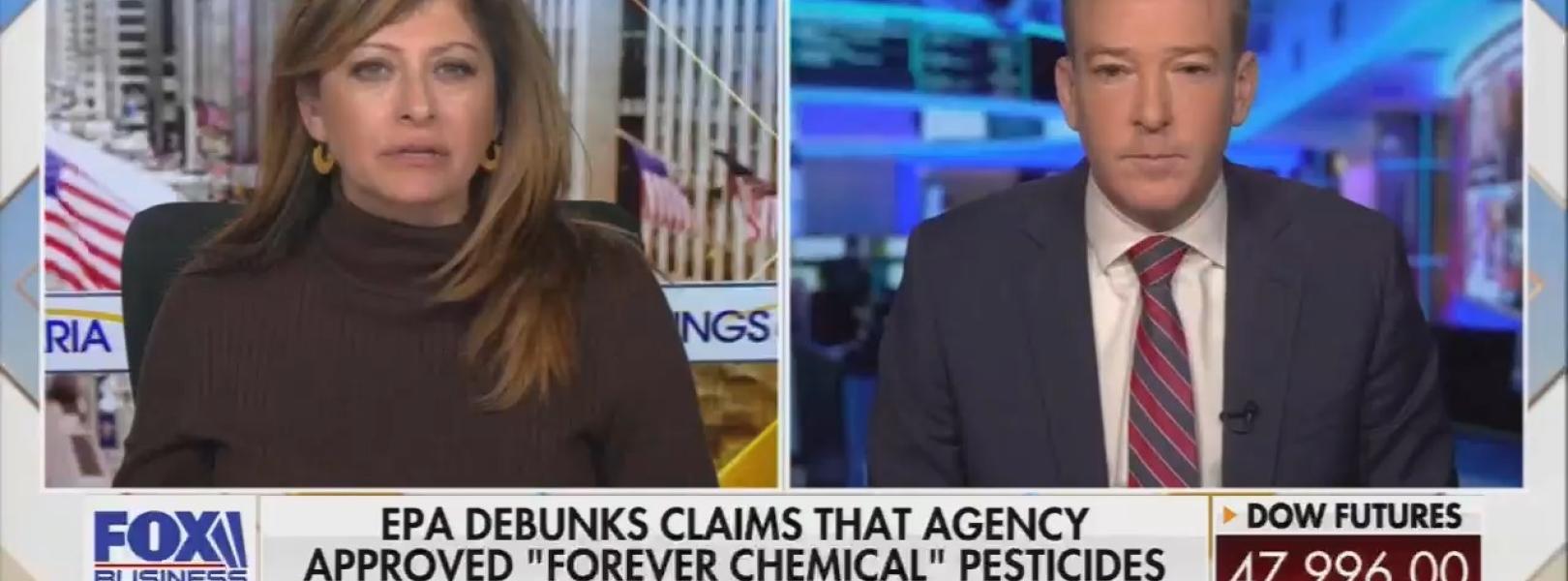
Bartiromo said during the segment, “Environmental advocates and critics are calling these forever chemicals” and warning of “long-term risks like reproductive issues and liver toxicity.” She added, “The EPA fact-checking that as misinformation. … What can you tell us?”
Not only did Bartiromo fail to mention the MAHA component of those “environmental advocates” — a broad public health effort that helped Trump win the election — but she also referred to a November 26 “fact check” on the EPA’s website claiming to debunk “false claims that agency recently approved ‘Forever Chemical’ Pesticides” with PFAS. However, the most widely accepted definition, from the Organisation for Economic Co-operation and Development, which was developed by an international group of scientists, does classify these recently approved substances as PFAS. According to the Natural Resources Defense Council, a similar definition is “already in use in 23 states.”
Zeldin defended the agency, saying, “It’s not forever chemicals. It’s actually better and safer than what it is replacing.” Zeldin continued, “There are some people, though, whenever they see something on the internet, they just take it at its word.”
Earlier in the interview, Bartiromo brought up Michigan Gov. Gretchen Whitmer, saying she’s “leading a charge with six other Democrat governors, urging the EPA to monitor and collect data on microplastics in drinking water by adding them to the unregulated contaminants list under the Safe Drinking Water Act.”
Again, she avoided mentioning MAHA, even though Kennedy has called attention to the issue, and a September strategy report from the “MAHA Commission to President Donald J. Trump” highlighted the need to evaluate “the risks and exposures of microplastics and synthetics, including in common products such as textiles.”
Zeldin dodged the question about microplastics, saying, “This isn’t a new issue,” and then praised an ExxonMobile refinery for “innovation with plastic recycling,” saying it’s “taking a plastic and they are getting it right down to its original raw chemical compound.”
Zeldin was describing chemical recycling, a process that experts say is not an effective way to reduce plastic pollution. The facility he praised, in Baytown, Texas, has faced strong opposition from Texas residents. Environmental groups also sued Exxon for repeated violations of federal air pollution limits at the facility, leading to a $14.25 million civil penalty.
“You’ve been doing a great job there running the EPA,” Bartiromo concluded.