trump fox flag

Molly Butler / Media Matters | Photo credit: Gage Skidmore via Creative Commons

Research/Study Research/Study

From tariffs to war, Fox demands Americans sacrifice their well-being for Trump's agenda

A year since the announcement of President Donald Trump’s illegal tariffs and just over a month since he launched a war against Iran without congressional authorization, it’s clear that both policies have been utter disasters. Trump’s economic policies have resulted in reaccelerated inflation and anemic job growth, while his military misadventure in Iran grows ever more costly in federal funds, spiking fuel prices, and American casualties.

There is mounting evidence that Trump’s approaches have failed or backfired in spectacular ways by alienating U.S. allies and emboldening adversaries. Trump’s imposition of global tariffs was overturned by the Supreme Court, and the recent ceasefire reached between the U.S. and Iran reportedly leaves Iran in a position of control of the Strait of Hormuz. Despite this, Fox News personalities have repeatedly urged Americans to bear the consequences of Trump’s chaotic policies as a “sacrifice” for promised economic and national security benefits that have not come to pass.
  • Fox has urged Americans to “sacrifice” for Trump’s agenda

    • After the 2024 election, Fox personalities called for the public to accept that Trump’s second-term agenda would harm the economy. In November 2024, Fox host Laura Ingraham said that Trump’s agenda would be “tough for the economy. There is no doubt about it.” She added: “People have to get, as my father would have said, real work, real jobs. People are going to have to get jobs and they're going to be scrambling.” In December 2024, then-Fox contributor Tammy Bruce (whom Trump recently appointed to serve as a deputy ambassador to the United Nations) said it was good that federal workers would lose jobs because “more jobs will be created in the private sector for them.” A week later, Fox host Todd Piro said: “Now, admittedly, we're going to have some tariffs, and that's going to raise prices. But the overall impact on the economy, hopefully, when Trump takes over, will make people feel better. And then when people feel better, the economy is better.” [Media Matters, 3/3/25; United States Mission to the United Nations, 12/29/25]
    • In January 2025, Fox cited JPMorgan Chase CEO Jamie Dimon and nebulous “national security” interests to dismiss concerns over increased inflation from Trump’s tariffs. On CNBC, Dimon said of Trump’s tariff plans at the time: “If it is a little inflationary, but it's good for national security, so be it. I mean, get over it. National security trumps a little bit more inflation.” Fox personalities echoed Dimon. Fox Business host Jackie DeAngelis said: “If we see a little inflation because we’re going to bring business back home here, and because we’re going to grow the American economy? As Jamie Dimon earlier said, so be it.” Then-Fox host Jeanine Pirro said: “Jamie Dimon now saying, well, you know, even if it is a little bit inflationary, if it’s good for national security — everybody’s coming around.” Fox Business host Charles Payne said that following Dimon’s defense of Trump’s tariff plans, “people are kind of taking a second look at this.” [Media Matters, 1/24/25; Fox News, The Five, 1/23/25]
    • In February and March 2025, Fox pushed the dubious framing of Trump’s tariffs on Canadian, Chinese, and Mexican imports as necessary to save American lives from fentanyl trafficking. Fox contributor Lisa Boothe said Trump “is trying to save Americans from the fentanyl crisis … they’re smuggled across the northern and southern border in Mexico and Canada.” Boothe added: “That’s what these tariffs are about. He’s just trying to save American lives.” Fox Business correspondent Lydia Hu said, “I think it's also important to remind everyone why President Trump is doing this. This is about the flow of illegal migration and drugs.” Hu added that Trump “wants zero deaths from fentanyl.” Many other Fox personalities claimed the tariffs were part of a “drug war,” not a trade war. But the reality was that the Trump administration had taken actions to weaken the interdiction of drugs coming into America since his second term began, Trump repeatedly offered other rationales for instituting tariffs on Canada and Mexico, and Canada was never a major conduit for fentanyl smuggling. [Media Matters, 3/5/25]
    • Fox personalities repeatedly acknowledged Trump’s tariffs would cause economic pain, but claimed they’re necessary to create jobs in the U.S. Fox & Friends co-host Steve Doocy said: “I'm seeing all of these stories about how the cost of a car built either in Mexico or Canada, or parts from it, could cost anywhere from an extra $4,000 to $12,000. … The president really needs to do some explaining about how we're just trying to get jobs back here. This is ultimately — there might be some pain in the beginning, but ultimately this is to help all of us.” DeAngelis said: “What I think Donald Trump is doing here — we have to bear with him while it could be a little painful — is to ride through that time that we bring manufacturing home and we incentivize companies to manufacture here.” Fox Business host Taylor Riggs dismissed reporting that Trump’s tariffs could raise car prices by up to 10%, saying: “This is sort of is Trump following through with his campaign promise of bringing jobs back to America.” Fox Business host Cheryl Casone said “iPhones are going to be $2,300” but argued that “the fight against China that Donald Trump has brought to the table has been successful and needed to happen.” On his radio show, Fox host Sean Hannity urged listeners to wait out the “minor pain” caused by Trump’s tariffs because “the long-term benefits are going to be massive.” [Fox News, Fox & Friends, 3/4/25; Fox News, The Faulkner Focus, 3/10/25; Fox News, Fox & Friends, 3/27/25; Fox News, Outnumbered, 4/4/25; Premiere Radio Networks, The Sean Hannity Show, 4/4/25]
    • Multiple Fox hosts have also told their audiences to accept the “sacrifice” of spiking gas prices caused by Trump’s war against Iran. Fox Business host Dagen McDowell and Fox anchor Martha MacCallum dismissed gas price spikes by invoking World War II rationing and “the big picture importance” of the war. Fox contributor George Murdoch, known as “Tyrus,” also invoked World War II sacrifice, adding: “The president said, yeah, you're going to feel a pinch, because this is what happens when you support the great American men and women” in the military. Fox & Friends co-host Ainsley Earhardt addressed critics and their concerns over higher oil prices: “Y'all can chill out for a little bit. It's worth it because Iran is not going to have a nuclear weapon now so this is the price we pay.” One of Earhardt’s co-hosts, Brian Kilmeade, said Americans should tolerate high gas prices as a “sacrifice” because “ultimately, we'll be saving money in the big picture.” Kilmeade added that the “sacrifice” was needed “to ultimately take down the enemy of our country for the last 47 years.” [Media Matters, 3/12/26]
    • Fox personalities repeatedly said Trump’s unnecessary Iran war was worth the “cost” and “sacrifice” of U.S. casualties. Kilmeade said: “There's going to be times where sadly we might have some casualties … but in the big picture, this president has shown more courage and this Pentagon, Pete Hegseth's Pentagon, has executed brilliantly once again.” DeAngelis said: “You never want to see casualties. You never want to see war. But you understand there's a cost for freedom as well.” Fox host Jesse Watters said: “Yes, there will be more casualties. That's horrible. But so far it's early, only six, and God bless these people.” Watters then added: “In about a month or two, Donald Trump will be visiting Beijing, and he will then — if this is a successful mission — have complete control over Chinese oil imports. That is a lot of clout, and we hope it works out.” Ingraham said: “There are going to be momentary setbacks and obviously some tragic human losses. But will the country, our country, be in a stronger geopolitical position — probably economic position — you know, are we in a better position now than we were two weeks ago? I would say absolutely that's the case.” Fox senior strategic analyst Jack Keane said: “We certainly grieve and mourn and honor the seven troops that we have lost,” adding: “With conviction, knowing what they sacrificed here, we’re pursuing these objectives with deliberateness and vengeance to get this job done.” [Fox News, Fox & Friends, 3/1/26, 3/3/26; Fox News, The Five, 3/4/26; Fox News, The Ingraham Angle, 3/9/26; Fox News, Hannity, 3/10/26]
  • Trump’s agenda of mayhem has hurt the US while failing to realize promised gains

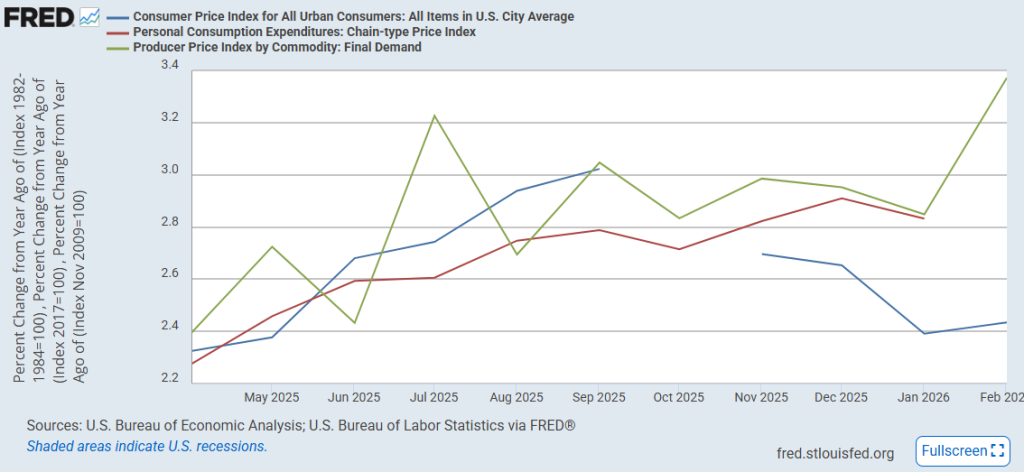
    • Three primary measures of inflation remain higher than they were in April 2025, when Trump announced his global “Liberation Day” tariff regime. Throughout the 2024 presidential campaign, Fox repeatedly touted Trump’s promises to “immediately bring prices down.” In the year since Trump unveiled his sweeping tariff agenda on April 2, 2025, which he dubbed “Liberation Day,” the prices paid by American consumers — as measured by the consumer price index, personal consumption expenditures price index, and producer price index — have not fallen as promised and have largely continued to increase, mostly at higher rates. [Federal Reserve Bank of St. Louis, accessed 4/2/26; Media Matters, 2/25/25, 4/1/25]
  • A graph of CPI, PPI, and PCE inflation between April 2025 and February 2026
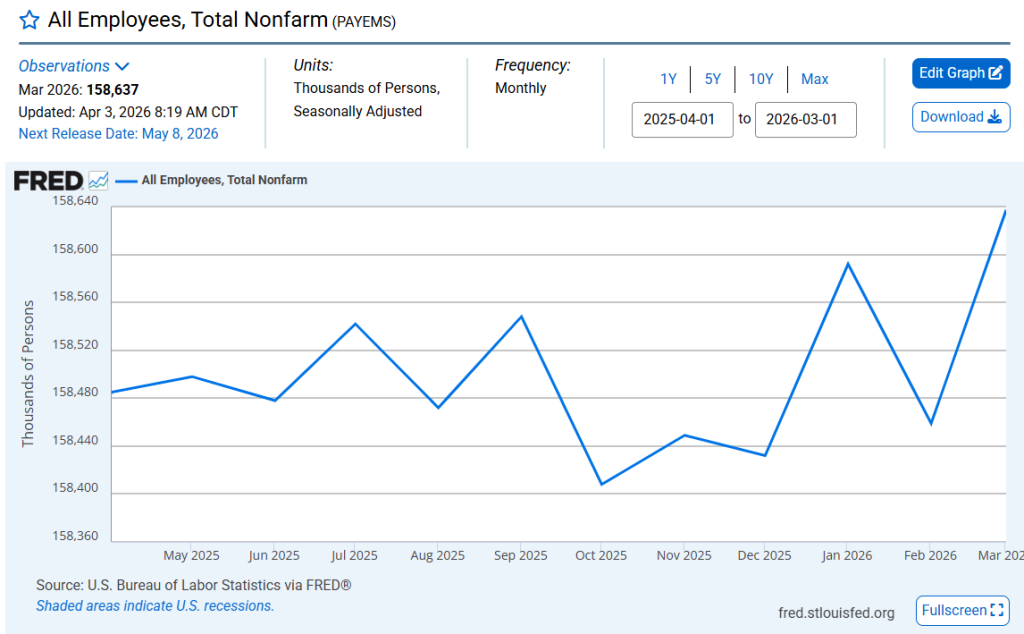
    • Total employment levels have barely grown since Trump’s announcement of global tariffs in April 2025. In total, the U.S. has only 152,000 more jobs today than it did last April, with several months of job loss so far. Multiple economists have tied this lack of jobs to the failures of Trump’s policies. Trump’s first year back in office produced only a measly 181,000 jobs, the lowest annual gain in jobs outside of a recession since 2003. [Federal Reserve Bank of St. Louis, accessed 4/3/26; Media Matters, 3/6/262/12/26; Bloomberg, 2/11/26]
  • A graph showing a small gain in jobs over the past 11 months
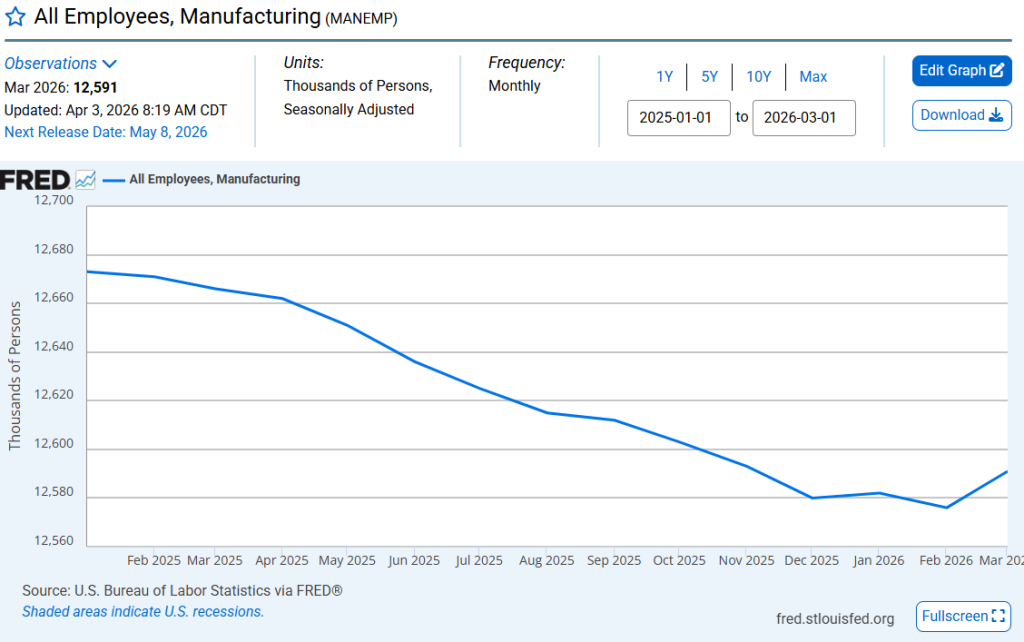
    • The manufacturing sector has lost 82,000 jobs since January 2025. In April 2025, Trump promised that “jobs and factories will come roaring back into our country” due to his tariffs, but the sector has mostly consistently lost jobs since his second inauguration in January 2025. [Federal Reserve Bank of St. Louis, accessed 4/3/26; CBS News, 3/6/26]
  • A graph showing the loss of manufacturing jobs since January 2025
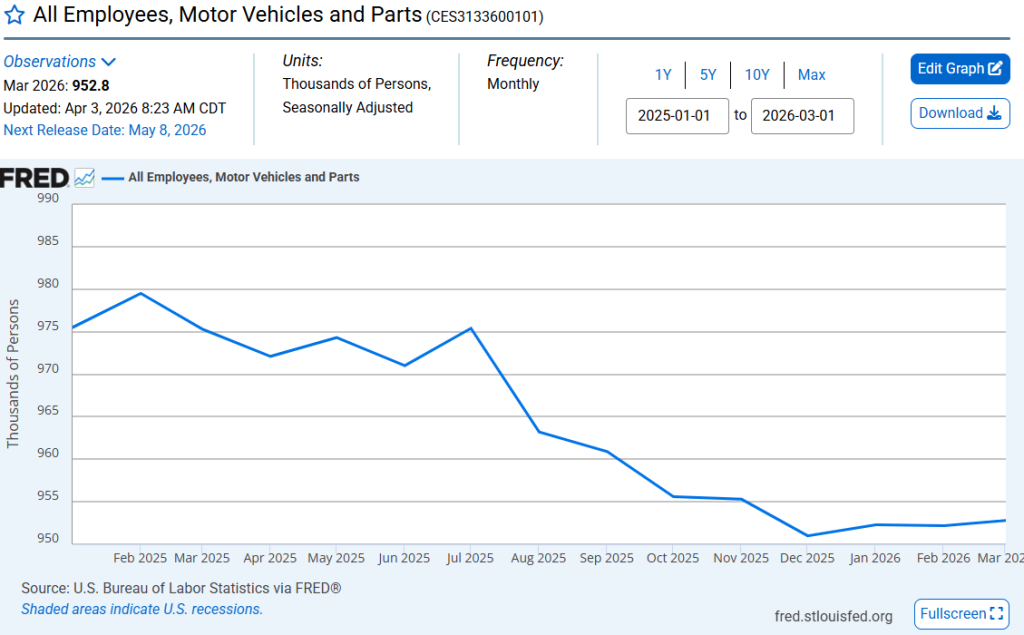
    • The auto manufacturing sector alone has lost over 22,000 jobs since January 2025. Trump claimed during his presidential campaign that the auto industry would face a “bloodbath” if he wasn’t elected. [Federal Reserve Bank of St. Louis, accessed 4/3/26; Media Matters, 7/25/25]
  • A graph showing a decline in auto manufacturing jobs since January 2025
    • Trump’s tariffs have undermined U.S. national security by alienating allies, causing some to turn to China. In a post coinciding with the anniversary of “Liberation Day,” Council on Foreign Relations senior fellow Edward Alden explained that Trump’s “impulsive Liberation Day tariffs alienated allies, angered friendly trading partners, and proved mostly for naught with the court decision and the billions of dollars in tariffs that must now be refunded.” PBS News Hour foreign affairs correspondent Nick Schifrin explained in a report that Trump’s tariff and trade policies have caused Canada and European allies to improve trade relations with China. Peterson Institute for International Economics senior fellow Cullen Hendrix explained that NATO and other allies were negatively impacted by Trump’s tariffs, and “treating alliance partners like trade adversaries will further increase intra-alliance frictions, weaken collective deterrence, and invite potential adversaries—none better positioned than China—to exploit these divisions.” BBC noted that Canada has made trade agreements with China in response to Trump’s trade war, and Columbia Law School professor Petros Mavroidis explained that Trump’s tariffs have made it more difficult for Trump to enlist help from allies, saying: “How can you ask for co-operative behaviour when you screw them on trade? … You lose your soft power, which was the biggest advantage to the US. All of this is gone now and how do you build it back?” [Council on Foreign Relations, 4/2/26; PBS, News Hour, 1/29/26; Military.com, 2/21/26; BBC, 4/2/26]
    • Fox embraced Trump’s initial tariffs on Canada, China, and Mexico as necessary to reduce fentanyl deaths, but the decline in opioid-related deaths began under former President Joe Biden. According to KFF, opioid overdose deaths began declining in mid-2023. In January, the Centers for Disease Control and Prevention’s National Center for Health Statistics posted a report showing that “between 2023 and 2024, the drug overdose death rate involving synthetic opioids other than methadone decreased by 35.6%.” A May 2025 news release from the CDC, using estimated deaths, showed overdose deaths from fentanyl decreased by a further 36% in 2024. The most recent CDC data shows that the number of deaths from synthetic opioids other than methadone noticeably slowed its decline in 2025 compared to 2024. [KFF, 2/24/26; Centers for Disease Control and Prevention, 1/29/265/14/253/1/26]
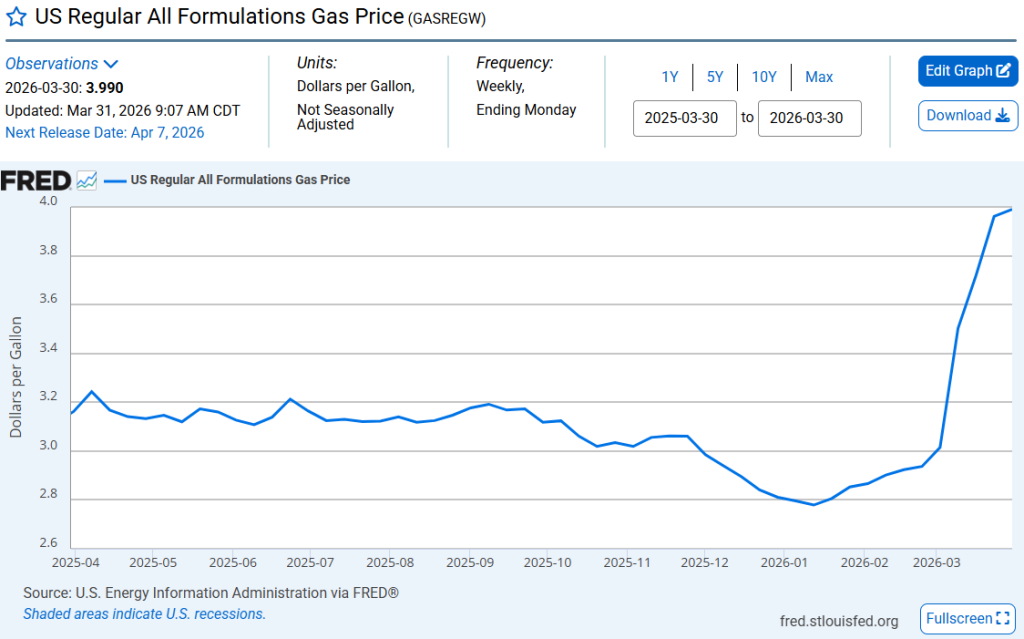
    • Gas prices have spiked significantly in the U.S. due to Trump’s war on Iran. On March 31, the national average gas price jumped past $4 per gallon for the first time since 2022. Gas prices began spiking immediately after Trump launched attacks on Iran at the end of February. During his campaign, Trump promised he would cut the price of gasoline in half. [The Associated Press, 3/31/26; Federal Reserve Bank of St. Louis, accessed 4/2/26; Popular Information, 4/1/26]
  • A graph showing a huge spike in gas prices beginning early March 2026
    • Contrary to Fox News’ claims that the war was necessary to stop a nuclear-armed Iran, Iran had no nuclear weapons, and reports say the U.S. intelligence community had determined Iran wasn’t working on building them prior to Trump’s attack. Agence France-Presse reported in mid-March that the U.S. intelligence community had concluded that “Iran was not rebuilding nuclear enrichment capacities destroyed last year by the United States and Israel, contradicting a key justification by President Donald Trump for his ongoing war.” The report also stated that “the UN nuclear watchdog and most observers have not supported the finding of an imminent nuclear bomb by Iran, which was negotiating with Trump's envoys on a deal in the days before the attack.” A backgrounder from the Council on Foreign Relations explained that according to the U.S. intelligence community, Iran had halted work on nuclear weapons back in 2003 and had adhered to the Joint Comprehensive Plan of Action negotiated in 2015 to curb its uranium enrichment until Trump abruptly abandoned the pact in 2018, with Iran taking further steps to increase enrichment following attacks by the U.S. and Israel in 2020 and later. [Agence France-Press, 3/18/26; Council on Foreign Relations, 10/27/23]
    • Multiple foreign policy experts called Trump’s ceasefire with Iran a “defeat” for the U.S. Arms control expert and former ambassador Greg Delawie shared a post from MeidasTouch calling Trump’s ceasefire with Iran “complete and utter capitulation,” adding: “Agreed, but let's take Trump's yes for an answer rather than the US becoming the kind of evil terrorist nation we have always opposed before.” Carnegie Endowment for International Peace senior fellow Ankit Panda called the outcome a “world historical scale defeat for the United States” due to “a loss of meaningful freedom of navigation” in the Strait of Hormuz. University of Illinois international relations professor Nicholas Grossman called the ceasefire “either … a humiliating defeat, leaving America in a weaker geopolitical position and Iran a stronger one,” or merely a “brief pause” that may “lead to more shooting,” concluding: “No matter what, it’s one of the stupidest, most unnecessary, most harmful US foreign policy choices ever.” International Crisis Group U.S. Program Director Michael Hanna stated: “We shouldn’t assume interim arrangements on Hormuz will endure, but I’ll note that accepting a strategic setback is far preferable than barreling into catastrophic military escalation. I of course think it’s fair to point out the self-defeating nature of this war but i’s not a reason for continuing.” Director of Columbia University’s Saltzman Institute of War & Peace Studies Elizabeth N. Saunders explained: “Trump backed down (good), but this is a win for Iran. Legitimates Iran’s control of the strait. He chose humiliation over escalation. For now. Or until he realizes he chose humiliation.” In another post, Saunders called it a “humiliating strategic defeat.” [Bluesky, 4/7/26, 4/7/26, 4/7/26, 4/7/26, 4/7/26, 4/8/26]