how-broadcast-tv-covered-climate-change-yearly

Melissa Joskow / Media Matters

Research/Study Research/Study

How broadcast TV networks covered climate change in 2025

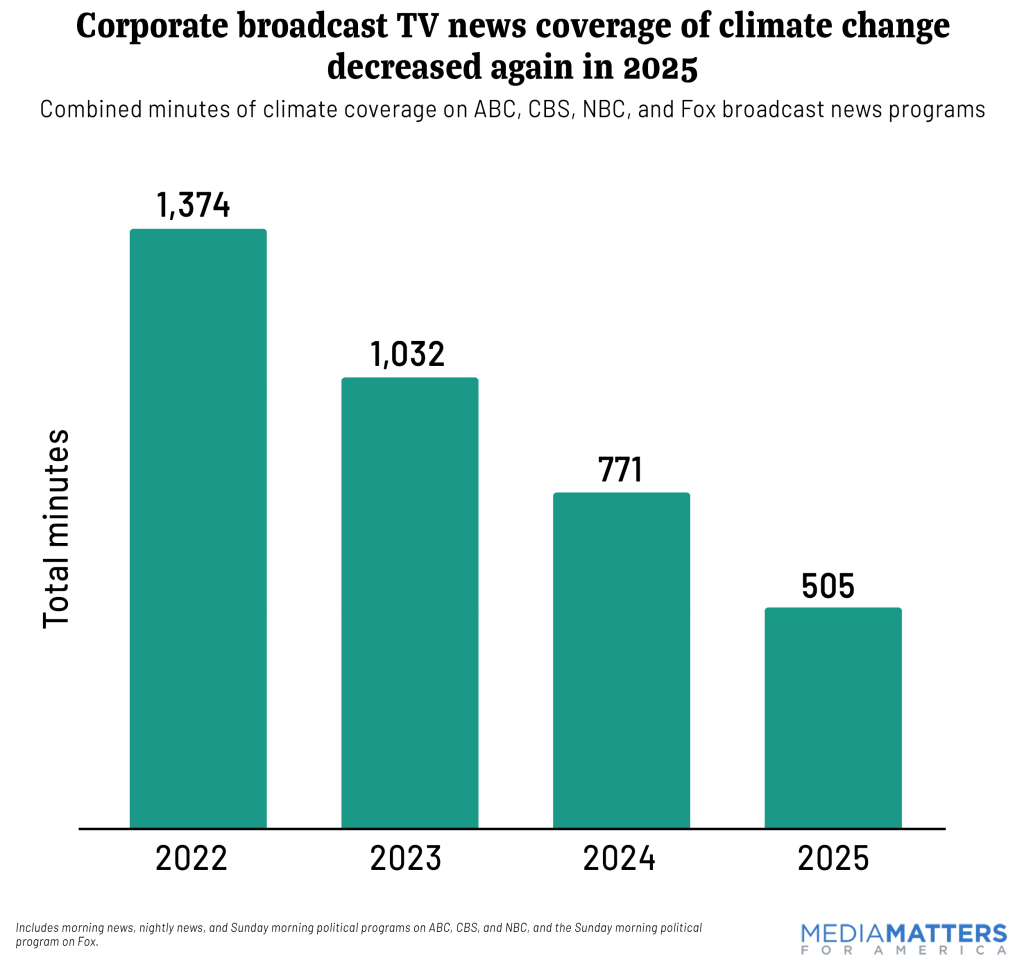
Corporate broadcast networks again reduced climate coverage in 2025, marking the third year coverage has declined since the networks' high-water mark of 23 hours of reporting in 2022. A Media Matters analysis found that ABC, CBS, and NBC aired a combined 8 hours and 25 minutes of climate coverage across 201 segments, a 35% decline from 2024.

This contraction occurred despite geographically widespread and disruptive climate impacts throughout the year, widening the gap between real-world climate risk and the information available to broadcast audiences.

Coverage continued to prioritize episodic disaster reporting over sustained attention to systemic drivers of climate change, fossil fuel accountability, scientific context, and the experiences of frontline and impacted communities. Climate mentions were most often tied to discrete events rather than incorporated into ongoing explanatory, accountability-driven, or policy-focused reporting.

The second Trump administration's major federal climate rollbacks — which have direct implications for public health, environmental protection, and community vulnerability — repeatedly intersected with destructive climate events in 2025, but were only intermittently integrated into corporate broadcast climate segments, limiting viewers’ ability to connect climate impacts to governance and regulatory decisions.

At the same time, newsroom disruptions and leadership changes, particularly at CBS, compounded a multi-year decline in broadcast climate reporting and reshaped the media landscape entering 2026. These shifts reduced institutional capacity for sustained climate journalism at a moment when climate impacts are accelerating and federal climate policy is undergoing rapid and consequential change.

  • Toplines

    • Overall decline: Corporate broadcast climate coverage declined 35% from 2024 to 2025, falling from 771 minutes to 505 minutes across 201 segments.
    • Fossil fuel accountability: Only 8% of climate segments mentioned fossil fuels, 16 of 201 total segments. CBS accounted for most of these mentions, while NBC and ABC referred to fossil fuels less frequently.
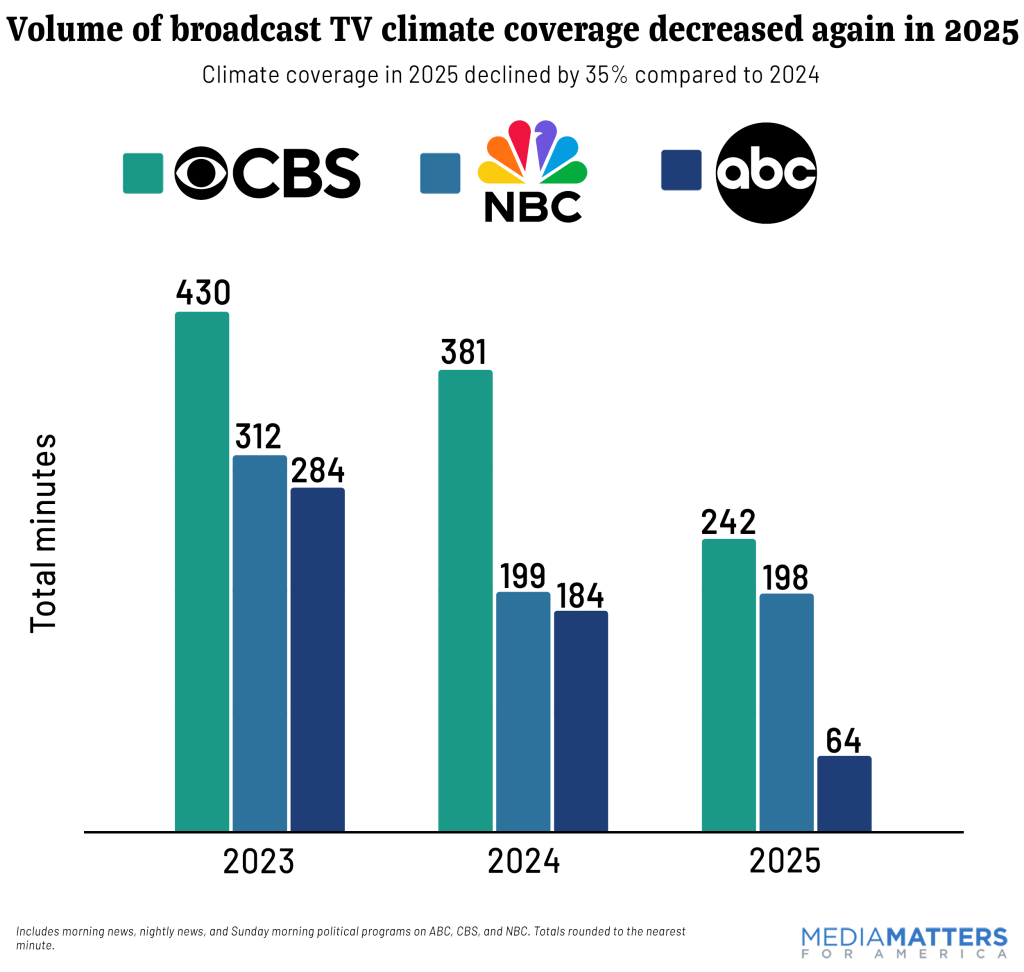
    • Network breakout: CBS led broadcast climate coverage for the fifth consecutive year, airing 242 minutes across 85 segments and accounting for 48% of total coverage time. NBC followed with 198 minutes across 82 segments. ABC aired 64 minutes across 34 segments.
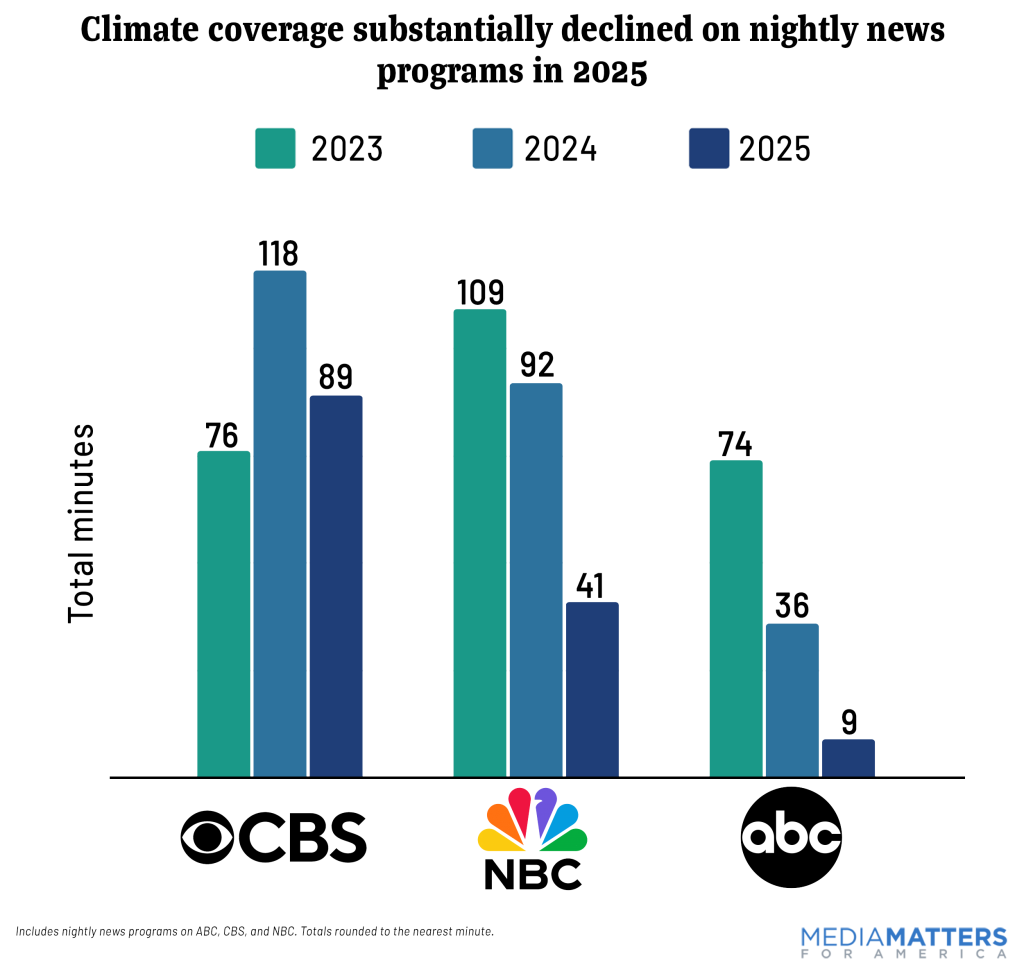
    • Nightly news: Broadcast nightly newscasts aired 140 minutes across 68 segments. CBS aired 89 minutes across 40 segments, NBC aired 41 minutes across 19 segments, and ABC aired 9 minutes across 9 segments.
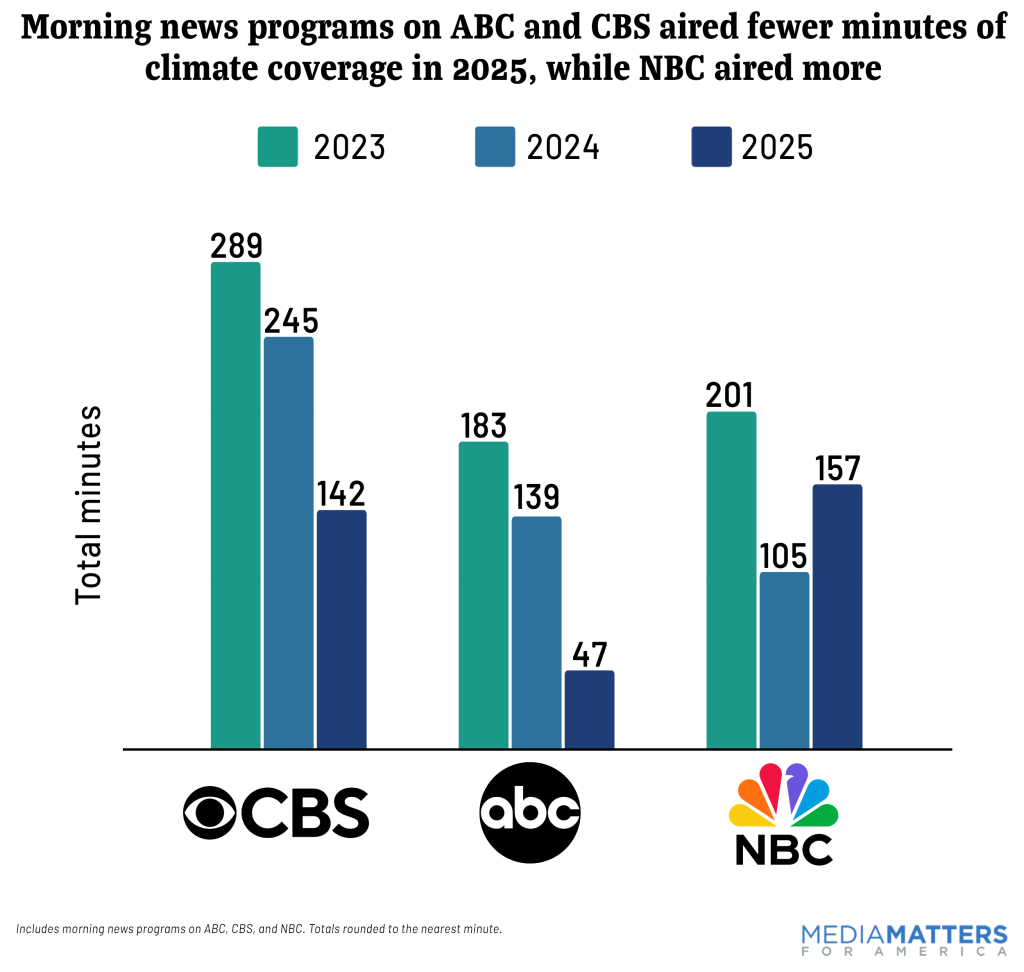
    • Morning news: Morning news programs aired 346 minutes across 127 segments. CBS aired 142 minutes across 41 segments, NBC aired 157 minutes across 63 segments, and ABC aired 47 minutes across 23 segments.
    • Sunday shows: Sunday morning political programs aired 19 minutes across 6 segments. CBS aired 11 minutes across 4 segments, and ABC aired 8 minutes across 2 segments.
    • Narrative drivers: Extreme weather was mentioned in 26% of climate segments, 53 of 201, down from 31% in 2024. Climate impacts appeared most frequently as a segment topic overall, while climate trends and systemic drivers were rarely discussed.
    • Trump climate actions: Broadcast networks referenced Trump administration federal climate actions in only 15% of total climate coverage. For comparison, 39% of PBS climate segments included discussion of these actions.
    • Climate solutions: Climate solutions, or actions to address climate change, were mentioned in 18% of climate segments, 36 of 201, down from 23% in 2024.
    • Climate justice: Climate justice appeared in 2% of climate segments, 4 of 201. 
    • Guest demographics: Broadcast networks featured 140 total guests in climate segments. White men accounted for 75 guests, or 54%. White women accounted for 41 guests, or 29%. Men of color accounted for 13 guests, or 9%, and women of color accounted for 11 guests, or 8%.
    • Credentials: Appearances by climate scientists and experts declined sharply compared to 2024. Corporate broadcast networks featured 7 climate scientists in 2025, down from 14, and 52 experts, down from 70.
  • Corporate broadcast news climate coverage continued to decline in 2025

  • Climate coverage in 2025 declined by 35% compared to 2024, from 771 minutes to 505 minutes. This marks a continued decline from the banner years of 2021 and 2022, when coverage exceeded 1300 minutes.  This contraction occurred even as climate impacts wreaked havoc across the country, widening the information gap between the scale of real world climate disruption and the depth, continuity, and explanatory context provided to corporate broadcast audiences.

  • Corporate broadcast tv news coverage of climate changed decreased again in 2025
  • 2025 climate coverage overview

    • For the fifth consecutive year, CBS led corporate broadcast climate coverage, airing 242 minutes across 85 segments. CBS accounted for 48% of total broadcast climate minutes in 2025.
    • NBC aired 198 minutes of climate coverage across 82 segments, accounting for 39% of total broadcast climate minutes. 
    • ABC aired 64 minutes of climate coverage across 34 segments, accounting for 13% of total broadcast climate minutes. 
  • Volume of broadcast TV climate coverage decreased again in 2025
  • Trump administration climate actions were largely absent from corporate broadcast climate coverage

  • The Trump administration advanced sweeping changes to federal climate policy in 2025including climate funding cuts, agency restructuring, regulatory rollbacks, and efforts to erase or restrict access to federal climate data. However, though these actions offered a consequential policy backdrop for climate reporting throughout the year, they appeared in only a small share of corporate broadcast climate segments. 

    • ABC, CBS, and NBC referenced Trump administration federal climate actions in 30 out of 201 segments, or 15% of total climate coverage.
      • CBS accounted for more than half of the segments that mentioned Trump administration climate actions, airing 16 such segments in 2025. NBC aired 10 segments that referenced federal climate or environmental policy changes, while ABC aired 4 such segments.
      • The most frequently mentioned federal actions involved climate funding cutbacks or freezes, which appeared in 10 segments, followed by efforts to gut or weaken federal agencies, which appeared in 8 segments. EPA policy rollbacks appeared in 5 segments

    This limited integration of federal climate policy into climate coverage reflects a broader pattern across administrations. In 2024, corporate broadcast networks mentioned Biden administration climate initiatives in only 6% of climate segments, even though it was a period of significant policy implementation. 

    In 2017, during President Trump's first term, 79% of climate coverage aired on corporate broadcast networks focused on statements or actions by the Trump administration. That coverage, however, was often driven by provocative rhetoric and political controversy and still failed to consistently examine material climate impacts, public health risks, national security implications, or economic consequences. 

    Across administrations, federal climate policy changes have largely been undercovered by corporate broadcast networks. The limited and episodic nature of this coverage constrained public understanding of how regulatory decisions intersected with climate impacts, community vulnerability, and long-term risk.

  • PBS coverage of Trump administration climate actions in 2025

  • In contrast to corporate broadcast networks, PBS NewsHour devoted sustained and substantive attention to Trump administration climate and environmental actions in 2025. PBS treated federal climate policy, regulatory rollbacks, and agency capacity as central subjects rather than incidental context.

    Throughout the year, PBS aired 87 climate segments, 39% of which referenced or included discussion of Trump administration climate actions. By comparison, corporate broadcast networks referenced Trump administration climate actions in just 15% of climate segments.

    Coverage highlights

    Notable PBS NewsHour climate segments addressing Trump administration actions included:

    • January 22 segment examining Trump’s declaration of a national energy emergency, withdrawal from the Paris Agreement, expansion of oil and gas drilling, rollback of greenhouse gas regulations, and efforts to withhold clean energy funding, situating these actions among established scientific warnings about fossil fuel-driven global warming.
    • March 24 segment featuring former EPA administrators Gina McCarthy and Christine Todd Whitman, who detailed the Trump administration's efforts to dismantle environmental regulations, dismiss scientists, and revisit the endangerment finding that greenhouse gases threaten public health.
    • December 26 segment that analyzed the administration's plans to dismantle the National Center for Atmospheric Research, with climate scientists warning that cuts to earth science and atmospheric research would undermine long term forecasting, preparedness, and understanding of climate change-driven weather change.

    By more consistently linking federal actions to their downstream effects on climate science, disaster response capacity, emissions trajectories, and public health, PBS NewsHour offered a level of policy continuity and explanatory depth largely absent from corporate broadcast climate reporting. 

    PBS NewsHour is discussed here to contextualize coverage of federal climate policy for comparison purposes only. PBS is excluded from corporate broadcast totals elsewhere in this report due to differences in funding structure and program format.

  • Morning news programs reduced climate coverage in 2025

  • Morning news programs aired 346 minutes of climate coverage across 127 segments in 2025, a decline from the 489 minutes aired in 2024. Morning shows remained the largest source of broadcast climate content, but reductions last year in both minutes and segments contributed substantially to the broader contraction in climate reporting.

  • Morning news programs on ABC and CBS aired fewer minutes of climate coverage in 2025, while NBC aired more
    • NBC aired 157 minutes across 63 segments, accounting for the largest share of morning climate segments.
    • CBS aired 142 minutes across 41 segments.
    • ABC aired 47 minutes across 23 segments.

    Our study includes ABC's GMA3, which airs for one hour on weekdays. Although it airs during the afternoon, we have categorized it as a morning show because it follows the same format and branding as ABC's Good Morning America, which airs for two hours Monday through Saturday and for one hour on Sunday.

    CBS Mornings airs Monday through Friday for two hours, as does CBS Saturday MorningCBS News Sunday Morning airs for 90 minutes.

    NBC's Today airs for four hours on weekdays, but our monitoring includes only the first three hours  — the main program (7-9 a.m.) and the third hour (9-10 a.m.)  — because the final hour, Today with Hoda and Jenna (now Today with Jenna and Sheinelle), is a lifestyle and entertainment show. This year’s study includes NBC News Daily, which airs on weekdays on local NBC broadcast stations and follows the format of NBC’s broader news programming.

    As in prior years, Sunday morning political shows were assessed separately and are not included in the morning news totals.

  • Nightly news programs’ climate coverage decreased in 2025

  • Corporate broadcast nightly news programs aired 140 minutes of climate coverage across 68 segments in 2025, a substantial decline from the 246 minutes aired in 2024. The reduction reflected fewer extended or in-depth climate segments across all three networks and contributed to the broader decline in broadcast climate visibility.

  • Climate coverage substantially declined on nightly news programs in 2025
    • CBS Evening News aired 89 minutes of climate coverage across 40 segments in 2025, maintaining its position as the leading source of nightly climate reporting despite a significant reduction from 2024.
    • NBC Nightly News aired 41 minutes across 19 segments.
    • ABC World News Tonight aired 9 minutes across 9 segments.
    • For comparison, PBS NewsHour aired 87 climate segments in 2025, continuing to exceed the corporate broadcast networks in total climate segments. As in prior years, PBS NewsHour is not included in the combined nightly totals due to differences in funding structure and program format.
  • Sunday morning political shows aired limited climate coverage

  • In 2025, Sunday morning political shows on ABC and CBS aired just 19 minutes of climate coverage across 6 segments, a decline from the 36 minutes aired in 2024. As a result, climate coverage remained rare on programs dedicated to political and policy analysis, limiting audiences’ exposure to climate as a core issue of governance.

    • CBS' Face the Nation aired 11 minutes across 4 segments.
    • ABC’s This Week aired 8 minutes across 2 segments.
    • NBC’s Meet the Press did not air any climate segments in 2025. (In 2024, Meet the Press aired 2 minutes in a single segment, matching its 2023 coverage level.)
    • Fox News Sunday did not air any climate segments in 2025.
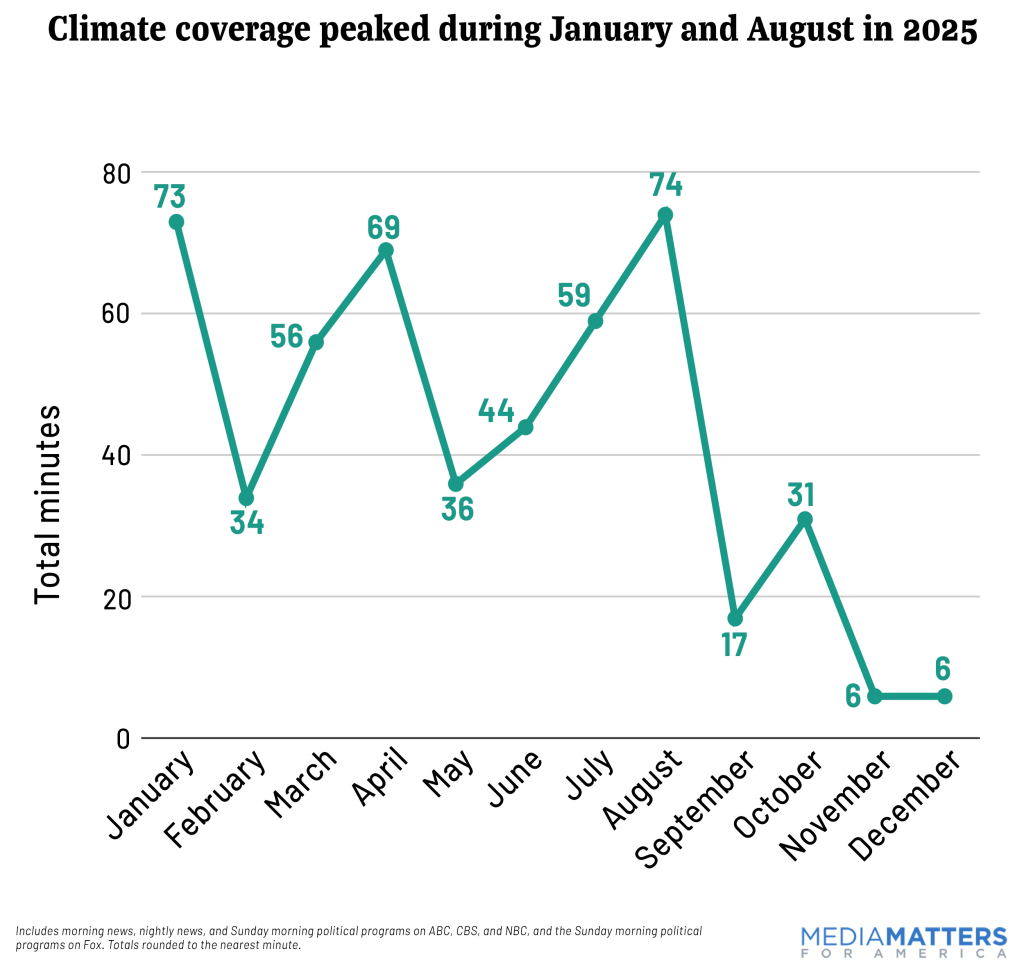
  • Climate coverage peaked during January and August

  • In 2025, broadcast climate coverage peaked during two distinct periods rather than during a single sustained season. Climate reporting surged in January, driven largely by extensive coverage of the Los Angeles wildfires, and again in August, when networks focused on extreme heat, wildfire impacts, and late summer flooding.

  • Climate coverage peaked during January and August in 2025
    • In January, morning news programs aired 38 minutes of climate coverage, nightly news programs aired 32 minutes, and Sunday morning political shows aired 3 minutes. CBS aired 54 minutes of climate coverage in January, making it the network’s peak month.
    • Climate coverage reached its highest monthly total in August, when networks aired a total of 74 minutes across 26 segments. In August, morning news programs aired 54 minutes of climate coverage, while nightly news programs aired 15 minutes, and Sunday morning political shows aired 4 minutes. NBC aired 40 minutes of climate coverage in August, making it the network’s peak month.
    • April and July also saw elevated levels of climate coverage. In April, networks aired 69 minutes across 25 segments. In July, networks aired 59 minutes across 28 segments.
  • Climate coverage revealed ongoing demographic disparities

  • In 2025, broadcast climate coverage continued to reflect significant demographic disparities among featured guests. Climate segments disproportionately featured white men, while women, people of color, frontline community members, and impacted residents remained underrepresented across corporate broadcast news.

    Climate coverage in 2025 featured mostly white men as guests

    • Across ABC, CBS, and NBC, climate segments featured 140 total guests in 2025. 
    • Men accounted for 63% of guests, while women accounted for 37%
    • White guests made up 83% of all appearances, with white men alone accounting for 54% of total guests. People of color accounted for 17% of guests, including 7 Black guests and 6 Hispanic guests.

    Frontline and impacted community representation remained limited in 2025

    Media Matters identifies three groups most affected by climate change: frontline communities, impacted communities, and first responders. Broadcast coverage in 2025 continued to underrepresent these voices.

    • Across all climate segments, we coded 29 guest appearances as including members of frontline communities, impacted communities, or first responders. Of these, 14 appearances were by impacted community members, defined as individuals directly affected by climate-related events impacting their homes, livelihoods, infrastructure, or local economies. 
    • Only 3 appearances included frontline community members, defined as those living near fossil fuel infrastructure or uniquely affected by ongoing climate-related health and environmental burdens.

    Expert representation declined as appearances by climate scientists remained limited

    Climate coverage in 2025 featured fewer expert voices — like researchers, public health professionals, and technical specialists such as atmospheric scientists and engineers —  than in 2024, narrowing the range of scientific and technical perspectives available to viewers. 

    Networks featured 52 experts in 2025, down from 70 in 2024. Climate scientist appearances declined further, with just 7 climate scientists appearing across all three networks, compared to 14 in 2024.

    • CBS featured the largest share of expert and climate scientist appearances in 2025, with 31 expert guests and 5 climate scientists appearing in its climate coverage.
    • NBC featured 18 expert guests and 2 climate scientists.
    • ABC featured only 3 expert guests and did not feature any climate scientists in its climate coverage in 2025.

    Taken together, these demographic and credential patterns narrowed the range of scientific and  policy perspectives, as well as those of frontline and impacted communities, presented in broadcast climate coverage, leaving audiences with a partial and uneven picture of who is affected by climate change and who is positioned to explain its causes, consequences, and solutions.

  • Key drivers of corporate broadcast climate coverage in 2025

  • Climate reporting in 2025 was shaped primarily by three drivers: extreme weather, climate impacts, and climate solutions. As in prior years, extreme weather and climate impacts accounted for most broadcast climate coverage, while solutions appeared far less frequently. Together, these patterns reflected a continued emphasis on event-driven coverage rather than sustained attention to systemic causes or long-term responses.

    Extreme weather

    In 2025, the United States experienced persistent and costly extreme weather without a single event or season dominating the national narrative — with one clear exception. The January 2025 Los Angeles wildfires, which represented one of the most visible and costliest wildfire disasters in history, briefly concentrated national attention. Despite garnering the highest amount of climate mentions, coverage of the Los Angeles wildfires only incorporated a small amount of climate context. For example, over a two-day period, only 3% of broadcast segments about the fires (2 of 59) mentioned climate. 

    Outside of the Los Angeles fires, climate impacts unfolded unevenly across regions and months. According to Climate Central, 2025 ranked as the third-highest year on record for billion-dollar climate disasters, with 23 events causing an estimated $115 billion in damages. Severe storms occurred frequently and often in overlapping sequences, while other catastrophic events, including floods, heat waves, and drought-related impacts like reduced water supply and increased wildfire risk, were regional or localized. This pattern produced a steady cadence of disasters rather than a single event that sparked sustained national focus, contributing to fragmented and episodic broadcast climate coverage.

    Coverage highlights

    Extreme weather was mentioned in 26% of all climate segments in 2025 (53 out of 201), a decrease from 2024, when extreme weather appeared in 31% of climate segments.

    Morning news programs mentioned extreme weather in 29 climate segments.

    • NBC aired 14 segments.
    • CBS aired 12 segments.
    • ABC aired 3 segments.

    Nightly news programs mentioned extreme weather in 23 climate segments.

    • CBS aired 11 segments.
    • NBC aired 10 segments.
    • ABC aired 2 segments.

    Sunday morning political programs mentioned extreme weather in 1 climate segment.

    • CBS aired 1 segment.

    The most frequently covered extreme weather events, all of which involved large-scale death, damage, or disruption, were:

    While extreme weather served as the most common impetus for climate coverage in 2025, reporting remained concentrated on a small number of high-profile disasters — especially the Los Angeles wildfires. Many climate-driven extreme weather events that were regional, slower-moving, or less visually dramatic received little or no sustained national broadcast coverage, even in a year marked by near-record disaster frequency and damage.

    Climate impacts

    Broadcast networks aired 150 climate segments that included at least one climate impact in 2025, making climate impacts the primary driver of corporate broadcast climate coverage. As in prior years, most impact-focused segments emphasized weather-related consequences rather than nonweather or systemic effects.

    Coverage highlights

    • Weather-related impacts accounted for 101 mentions, reflecting continued emphasis on the immediate and visible consequences of climate change.
    • Among nonweather impacts, public health impacts were mentioned most frequently, with 28 mentions, including coverage of heat-related illness, lengthening allergy seasons, and disease spread. Impacts on the natural environment received 25 mentions, reflecting coverage of ecosystem disruption, biodiversity loss, marine impacts, melting ice, and ocean-related change, while national security impacts received 5 mentions.
    • Coverage of economic and insurance impacts declined notably from the prior year. In 2025, economic and insurance impacts were mentioned a combined 21 times, down from 35 mentions in 2024, when economic and insurance disruption represented the most frequently mentioned nonweather climate impact.

    Notable segments

    Notable coverage of climate impacts across major networks in 2025 included a segment aired during the April 18 episode of ABC’s GMA3 linking climate change to longer and more intense allergy seasons, explaining how warmer winters and extended growing periods increase pollen exposure and respiratory health risks. During the January 11 episode of NBC’s Today, correspondent Christine Romans reported on how climate-driven wildfire risk contributes to rising insurance costs and policy nonrenewals, leaving homeowners increasingly underinsured. And the January 6 episode of CBS Evening News featured a segment examining how a climate-driven marine heatwave led to the collapse of the snow crab population in Alaska, threatening both ecosystems and the livelihoods of fishing communities. 

    While climate impacts remained a major component of broadcast climate coverage in 2025, reporting often stopped at describing consequences rather than explaining their structural causes. Segments frequently documented how climate change was worsening fires, flooding, health risks, and ecological disruption, but far less often connected those impacts to federal climate policy, fossil fuel dependence, or long-term emissions trajectories. As a result, audiences were more likely to encounter climate change as a series of escalating effects than as a problem shaped by identifiable policy choices and economic systems.

    Climate solutions

    Climate solutions appeared in fewer than 1 in 5 climate segments in 2025. Across ABC, CBS, and NBC, solutions appeared in 36 climate segments, accounting for 18% of total climate coverage, a decline from 23% in 2024. Like in 2024, adaptation-focused segments continued to lead climate solutions coverage in 2025, reflecting the ongoing need for communities to build resilience against climate impacts affecting infrastructure, agriculture, and public health.

    • CBS led broadcast solutions coverage in 2025, airing 19 solution-related climate segments. NBC aired 10 solution-focused segments, while ABC aired 7 such segments.

    Coverage highlights

    • Adaptation dominated climate solutions coverage in 2025, appearing in 14 climate segments. Clean electricity production appeared in 6 climate segments.
    • Transportation-related solutions appeared sporadically, in only 2 segments.

    Notable segments 

    Notable coverage of climate solutions across major networks in 2025 included a segment aired during the April 21 episode of ABC’s Good Morning America that explored how climate mitigation is driving the development of lower-carbon building materials. The January 11 episode of CBS Saturday Morning examined how the city of Barcelona is using tourism tax revenue to fund solar-powered cooling upgrades in public schools as a response to worsening heat and drought. And the April 25 episode of NBC’s Today featured a segment that focused on resilient architecture and design strategies intended to protect homes and communities from increasingly destructive climate events.

    As in previous years, climate solutions coverage in 2025 tended to focus on discrete projects, pilot efforts, or lifestyle-oriented actions rather than sustained discussion of systemic emissions reductions, regulatory approaches, or large-scale transitions away from fossil fuels. The contraction in solutions coverage and its concentration within a limited set of approaches further narrowed audiences’ exposure to the scope and scale of responses required to address the climate crisis.

  • Climate stories that were undercovered in 2025

  • Several consequential climate issues received limited broadcast attention in 2025, resulting in sparse or episodic coverage relative to their policy, economic, and public health significance. As in prior years, broadcast networks struggled to sustain coverage of climate stories that require ongoing explanation rather than event-driven reporting.

    Structural gaps persisted in coverage of global climate governance, fossil fuel accountability, and climate justice, even as these issues played central roles in shaping climate risk, vulnerability, and policy decisions throughout the year. Federal climate activity appeared only intermittently in climate segments despite its relevance to impacts and exposure. (A fuller accounting of coverage of Trump administration actions appears earlier in this analysis.)

    COP30

    Corporate broadcast networks provided minimal coverage of the United Nations climate conference, COP30, in 2025. The Conference of the Parties is an annual global summit where world leaders, scientists, and advocates negotiate international climate policy. COP30 focused on climate finance, emissions reduction commitments, and adaptation strategies for developing nations. Despite the conference’s importance, broadcast coverage remained limited, leaving global climate negotiations largely absent from national news programming.

    Coverage highlights

    Corporate broadcast networks mentioned COP30 in 8 climate segments in 2025, up from 4 segments covering COP29 in 2024. Despite the increase in COP segments compared to last year, corporate broadcast networks have historically undercovered the conference. 

    • ABC aired 5 segments mentioning COP30.
    • NBC aired 2 segments.
    • CBS aired 1 segment.

    Climate justice

    Coverage of climate justice declined further in 2025, continuing a multi-year downward trend. Climate justice focuses on the disproportionate impacts of climate change on socially marginalized communities and the need for equitable responses to global warming. Broadcast coverage of these issues can play a critical role in highlighting disparities and informing public understanding of inclusive climate policy.

    Coverage highlights

    Corporate broadcast networks mentioned climate justice in 4 climate segments in 2025, accounting for 2% of total climate coverage. This represents a decline from 11 segments in 2024 and 21 segments in 2023.

    • CBS mentioned climate justice in 3 segments.
    • ABC mentioned climate justice in 1 segment.
    • NBC did not mention climate justice in any climate segments in 2025.

    Fossil fuel accountability

    With audiences of millions, corporate broadcast networks are well positioned to examine how fossil fuel production and consumption drive global warming, shape climate impacts, and influence public health and economic risk. In 2025, however, fossil fuel accountability remained persistently undercovered.

    Coverage highlights

    Corporate broadcast networks mentioned fossil fuels in the context of climate change in 8% of climate segments in 2025, or 16 out of 201 segments. This represents a decline from 9% percent in 2024.

    • CBS mentioned fossil fuels in 10 segments.
    • ABC mentioned fossil fuels in 4 segments.
    • NBC mentioned fossil fuels in 2 segments.

    The limited attention to fossil fuel accountability constrained broadcast audiences’ ability to understand the primary driver of global warming, thereby limiting the context surrounding climate impacts, policy debates, and mitigation efforts.

  • State of the Media Landscape Entering 2026

  • The decline in broadcast climate coverage unfolded against intensifying political attacks on the press. Throughout 2025, the Trump administration escalated rhetorical attacks on journalists, took aggressive regulatory and legal actions, and expressed open hostility toward unfavorable reporting. Such conditions can narrow editorial risk tolerance, discourage sustained scrutiny of federal action, and incentivize coverage choices that avoid systemic or accountability-oriented frames. Coverage of federal climate rollbacks appeared only intermittently across broadcast networks in 2025, despite their direct relevance to climate impacts, public health, and economic vulnerability.

    As the country enters a pivotal midterm election cycle, these dynamics carry heightened significance. Broadcast news remains a central agenda setter, shaping not only national narratives but also the priorities of policymakers, regulators, and institutional decision-makers while continuing to reach large audiences. A sustained reduction in climate coverage risks leaving the public less prepared to understand the stakes of climate policy decisions, the material consequences of regulatory changes, and the growing disparities in climate risk across communities.

    Within this broader contraction, changes at CBS News carry outsized significance. For several consecutive years, CBS has played a leading role in broadcast climate journalism, routinely airing the highest volume of climate segments, featuring more climate scientists and experts than its peers, and devoting greater attention to climate solutions. That leadership functioned as an anchor within the broadcast ecosystem, helping to sustain climate visibility even as other networks fluctuated.

    That role was destabilized in October 2025, when Paramount Skydance installed Bari Weiss, founder of The Free Press, as editor-in-chief of CBS News. The newly created position granted Weiss broad authority over editorial priorities, and soon after her appointment, CBS dismissed most of its dedicated climate team as part of a newsroom restructuring, removing much of the institutional capacity responsible for the network’s climate coverage portfolio.

    The editorial implications of this shift are consequential. Under Weiss’s leadership, The Free Press has consistently elevated climate skeptics and contrarianspublished content that downplayed or misrepresented established scientific findings, and employed rhetorical frames long associated with right-wing media coverage of climate change. 

    CBS’ climate output has already shown a discernible decline since its change in leadership. After Weiss assumed editorial control in early October, CBS aired only 7 climate segments through the end of 2025, marking an immediate contraction in the network’s climate reporting footprint relative to earlier months in the year. One segment about youth climate anxiety aired during the December 29 episode of CBS Evening News elevated and echoed right-wing media’s approach to minimizing climate risk by laundering a narrative long used to shift attention away from climate consequences and responsibility toward cultural debates about individual life choices.

    These newsroom changes signal a looming void in the national climate information ecosystem. If CBS retreats from its prior role as the broadcast climate-reporting leader, responsibility for sustaining rigorous, science-based, and context-rich coverage will fall more heavily on NBC and ABC. 

    To meet that responsibility, broadcast networks must increase reliance on climate scientists, policy experts, and frontline communities; integrate federal climate actions and regulatory changes far more consistently into climate coverage; move beyond episodic weather reporting toward sustained examination of systemic drivers and solutions; and resist political and market pressures that undermine the visibility and credibility of climate journalism.

    Without such shifts, the contraction in climate coverage documented in 2025 risks deepening in 2026, at a moment when climate impacts are accelerating, federal policy is in retrenchment, and voters are approaching a consequential midterm election cycle with diminishing access to the kind of clear, comprehensive climate information needed to make informed decisions.

  • Methodology

  • Media Matters searched transcripts in the Nexis and SnapStream databases for ABC’s Good Morning AmericaGMA3World News Tonight, and This Week; CBS' MorningsSaturday MorningSunday MorningEvening NewsWeekend News, and Face the Nation; NBC’s TodayToday 3rd HourDaily NewsSunday TodayNightly News, and Meet the Press; Fox Broadcasting Co.’s Fox News Sunday; and PBS’ NewsHour for any of the terms and any derivations of the terms “climate,” “global warming,” “global heating,” “global temperatures,” “warmer planet,” “warming planet,” “planet warms,” “warmer globe,” “warming globe,” “globe warms,” “rising temperatures,” “hotter temperatures,” “green new deal,” “emissions,” “greenhouse gases,” or “net zero” from January 1, 2025, through December 31, 2025.

    We included any segment in which climate change was the stated topic of discussion, as well as news rundowns that included a substantial mention of climate change, which we defined as a paragraph or more of a news transcript or a block of uninterrupted speech by a host, anchor, or correspondent. We also included weather reports, which we defined as instances when climate change was mentioned in an extreme weather report by a meteorologist in front of a green screen. We also included instances of a guest mentioning climate change in a network correspondent segment if the context of the segment was clearly about a climate, energy, or environmental issue.

    When counting guest appearances, we included network employees — including paid contributors and analysts — if they appeared as part of a roundtable discussion on a Sunday morning political show. We did not include teasers if they were for segments that aired later during the same program. This review does not include “person on the street” interviews, in which an unnamed person in a transcript speaks briefly as a guest; however, in previous iterations of this study, we did include “person on the street” interviewees as guests.

    We timed identified segments using the Snapstream or Kinetiq video databases, or YouTube if a network posted the segment to that website.

    We rounded all times to the nearest minute and all percentages to the nearest whole number.