  • Online media
  • Iran
  • Epstein
  • Facebook
  • Instagram
  • YouTube
  • RSS
  • Take Action
  • Search
  • Donate

Media Matters for America

  • News & Analysis
  • Research & Studies
  • Audio & Video
  • Archives

Media Matters for America

  • Nav
  • Search
  • News & Analysis
  • Research & Studies
  • Audio & Video
  • Archives
  • Online media
  • Iran
  • Epstein
  • Take Action
  • Search
  • Donate
  • Facebook
  • Instagram
  • YouTube
  • RSS
CBS News’ climate anxiety segment laundered right-wing climate framing

Media Matters / Molly Butler

CBS’ leadership in broadcast news climate coverage is chipping away under Bari Weiss

Special Programs Climate & Energy

Written by Allison Fisher & Evlondo Cooper

Published 03/04/26 10:08 AM EST

In recent years, Media Matters' climate studies have found that CBS has played a leading role in broadcast journalism on the issue, routinely airing the highest volume of climate segments, featuring more climate scientists and experts than its peers, and devoting greater attention to climate solutions. That leadership has functioned as an anchor within the broadcast ecosystem, helping to sustain climate visibility even as other networks have fluctuated.

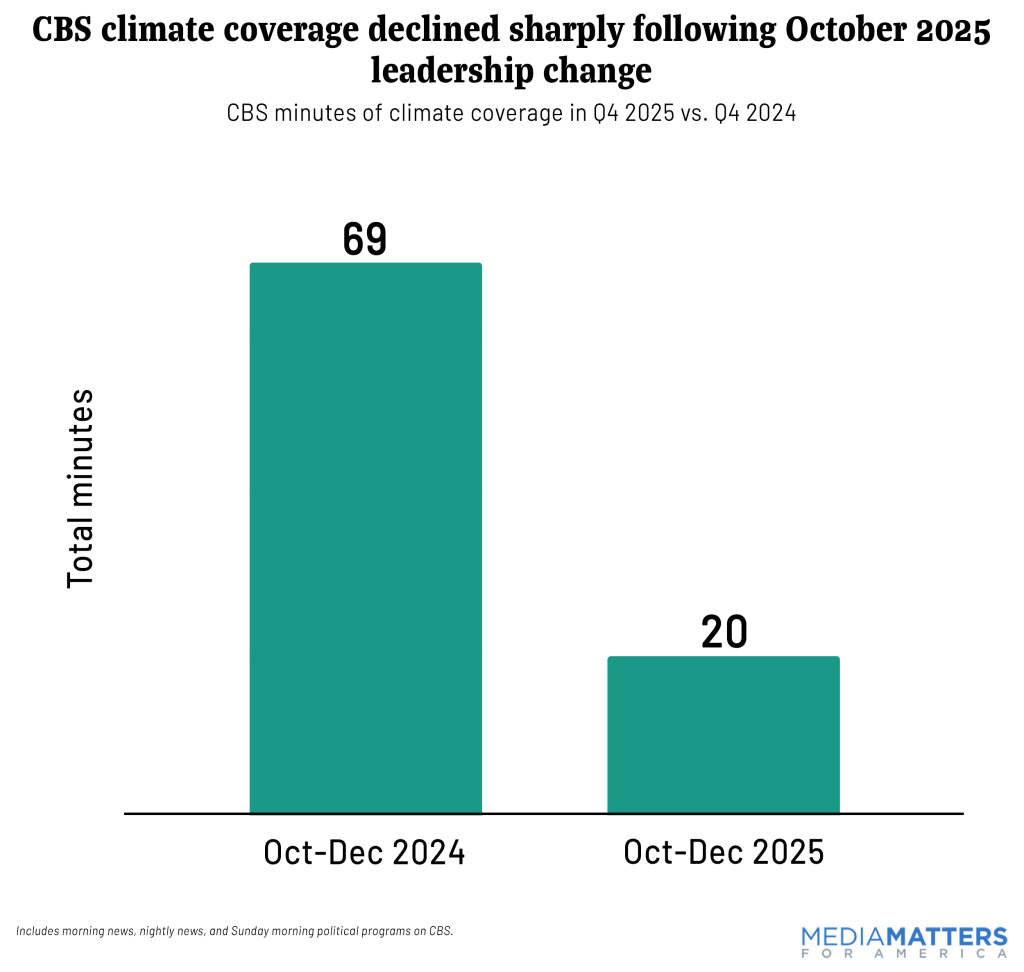
Now, tectonic shifts at the network, sparked by new ownership and Trump’s campaign targeting legacy media, means its leadership on climate coverage could be slipping away, with notable changes in tone and volume of coverage already underway. Even in 2025, as corporate broadcast news reporting on the climate crisis dropped to just over 8 hours — a significant decline from its 2022 zenith of nearly 23 hours — CBS still accounted for nearly half of that time. But the vast majority of its coverage aired before Bari Weiss was installed as its editor-in-chief, with only 20 minutes of climate coverage airing across 7 segments between Weiss’ takeover in October and the end of 2025. 
CBS has historically led its broadcast counterparts in climate coverage

For the fifth consecutive year, CBS has led corporate broadcast climate coverage. In 2025, CBS accounted for 48% of total broadcast climate minutes. Both its nightly news program, CBS Evening News, and its Sunday morning political show, Face the Nation, led their counterparts in climate programming.

But volume of coverage is not the only indicator cementing CBS’ role as the top climate communicator in corporate broadcast news. While networks underreported the Trump administration’s attacks on climate science and action overall, CBS accounted for more than half of the segments that did discuss the Trump administration’s climate actions. As in prior years, the network also led on solutions-related climate segments and coverage that included climate scientists. 

Shifts at the network put CBS’ future climate leadership in question

In October 2025, months after the Trump administration greenlit Skydance Media’s acquisition of CBS’ parent company, Paramount Skydance installed Bari Weiss, founder of The Free Press, as editor-in-chief of CBS News. The newly created position granted Weiss broad authority over editorial priorities, and soon after her appointment, CBS dismissed most of its dedicated climate team as part of a newsroom restructuring, removing much of the institutional capacity responsible for the network’s climate coverage portfolio. According to Heated, a memo announcing the layoffs from Paramount Skydance head David Ellison indicated that the network was “‘phasing out roles that are no longer aligned with our evolving priorities.’” Heated further reported that “today, the only person remaining at CBS News to cover climate change is national environmental correspondent David Schechter, who no longer has a dedicated producer.”

The editorial implications of this shift are consequential. Under Weiss’ leadership, The Free Press has consistently elevated climate skeptics and contrarians, published content downplaying or misrepresenting established scientific findings, and employed rhetorical frames long associated with right-wing media coverage of climate change. 

While journalists and staff exit CBS, Weiss is bringing on influencers who may not adhere to the same journalistic standards. One hire, Peter Attia, a controversial longevity influencer, has already resigned due to backlash over lewd emails he exchanged with late convicted sex offender Jeffrey Epstein. In a less-reported exchange, Attia shared an article with Epstein from prominent British climate skeptic Matt Ridley, who has argued that “global warming is good for us.”

Early signs that CBS is abandoning its leadership role in producing consistent and quality climate coverage

CBS’ climate output has already shown a discernible decline since its change in leadership. After Weiss assumed editorial control in early October, CBS aired only 7 climate segments through the end of 2025, marking an immediate contraction in the network’s climate reporting footprint relative to earlier months in the year and as compared to the same period in 2024.

CBS climate coverage declined sharply following oct 2025 leadership change

One segment about youth climate anxiety aired during the December 29 episode of CBS Evening News elevated and echoed right-wing media’s approach to minimizing climate risk by laundering a narrative long used to shift attention away from climate consequences and responsibility toward cultural debates about individual life choices.

In 2025, CBS aired 54 minutes of climate coverage in January, making it the network’s peak month. This year, the network aired only one climate segment in January — a headline report on the evening news lasting approximately 20 seconds on the surprising health of polar bears, despite the loss of sea ice, in the Norwegian Arctic. While the report may seem innocuous, it is not breaking news; a similar study appeared on a climate skeptic site in 2015, and the argument has been used by climate deniers to claim that alarmists were wrong about the severity of climate change and its impacts — in this case, on the “symbol of climate change,” the polar bear. The new study was also shared on climate denier Marc Morano’s site. With a seeming nod to the climate skeptic community, Evening News anchor Tony Dokoupil concluded: “Experts say the bears are still in trouble long term, but hey, the experts have been wrong before.”

Video file

Citation

From the January 29, 2026, edition of CBS Evening News

But the segment was not just a nod toward skeptics. It represents a choice on the part of CBS to report an outlier of the climate crisis rather than any number of studies or events that support the overwhelming consensus on global warming. These newsroom changes in quantity and quality of coverage, which bear the fingerprints of Weiss’ contrarian approach to news, signal a looming void in the national climate information ecosystem.

Conclusion

Broadcast news remains a central agenda setter, shaping not only national narratives but also the priorities of policymakers, regulators, and institutional decision-makers while continuing to reach large audiences. A sustained reduction in climate coverage risks leaving the public less prepared to understand the stakes of climate policy decisions, the material consequences of regulatory changes, and the growing disparities in climate risk across communities.

Within this broader contraction, changes at CBS News carry outsized significance. 

If CBS retreats from its prior role as the corporate broadcast climate-reporting leader, responsibility for sustaining rigorous, science-based, and context-rich coverage will fall more heavily on NBC and ABC. To meet that responsibility, broadcast networks must increase reliance on climate scientists, policy experts, and frontline communities; integrate federal climate actions and regulatory changes far more consistently into climate coverage; move beyond episodic weather reporting toward sustained examination of systemic drivers and solutions; and resist political and market pressures that undermine the visibility and credibility of climate journalism.

Without such shifts, the contraction in climate coverage documented in 2025 risks deepening in 2026, at a moment when climate impacts are accelerating, federal policy is in retrenchment, and voters are approaching a consequential midterm election cycle with diminishing access to the kind of clear, comprehensive climate information needed to make informed decisions.

The Latest

  1. Alex Jones praises Nick Fuentes: “You're the future, Nick. We're counting on you."

    Video & Audio 03/04/26 4:36 PM EST

  2. Megyn Kelly caller on Iran war: “I'm paying 67 cents a gallon more, not even a week later. ... It's not America first.”

    Video & Audio 03/04/26 4:29 PM EST

  3. Nick Fuentes says Trump’s “spin” on war with Iran is “childish” and "grating”

    Video & Audio 03/04/26 3:57 PM EST

  4. Laura Loomer lashes out at Megyn Kelly over Iran: “Shut up, you stupid bitch. ... You're not MAGA.”

    Video & Audio 03/04/26 2:28 PM EST

  5. Fox News hosts want to flood Iran with small arms to incite regime change

    Article 03/04/26 2:25 PM EST

Pagination

  • Current page 1
  • …
  • Next page ››

In This Article

  • Broadcast Networks

    Broadcast Networks

Related

  1. How broadcast TV networks covered climate change in 2025

    Research/Study 03/04/26 10:06 AM EST

  2. Corporate broadcast news fumbles January jobs report

    Article 02/12/26 4:45 PM EST

  3. Mainstream news coverage almost totally ignored Bannon’s extensive ties to Epstein

    Research/Study 12/11/25 2:19 PM EST

Media Matters for America

Sign Up for Email Updates
  • About
  • Contact
  • Corrections
  • Submissions
  • Jobs
  • Privacy Policy
  • Terms & Conditions
  • Facebook
  • Instagram
  • YouTube
  • RSS

© 2026 Media Matters for America

RSS