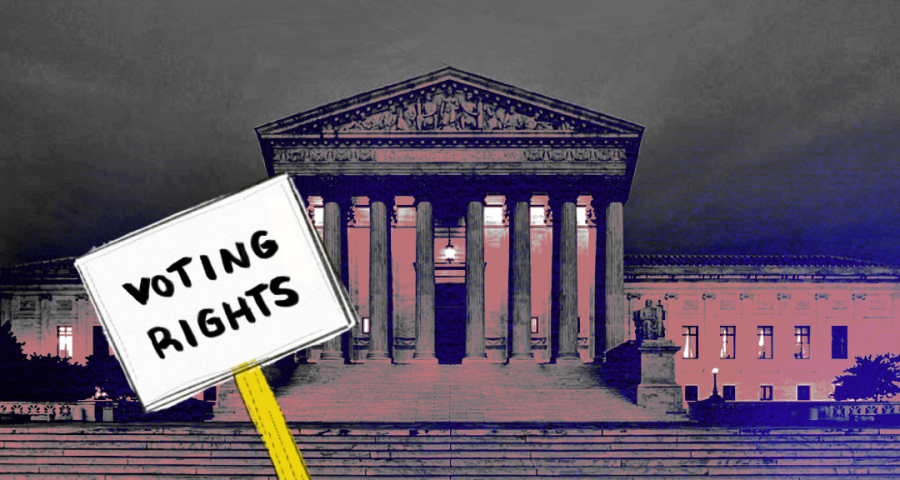
voting rights sign in front of SCOTUS

Andrea Austria / Media Matters

Research/Study Research/Study

Right-wing media celebrate SCOTUS ruling hollowing Voting Rights Act and deny negative impact on Black voters

Conservative pundits described majority-minority districts as “DEI” and “no-whites-allowed”

On Wednesday, the Supreme Court ruled against a Louisiana election map, narrowing the Voting Rights Act in what NPR described as “the latest in a series of rulings that have all but gutted the landmark 1965 law.” 

Right-wing media figures and outlets celebrated the ruling and described majority-minority districts as “DEI” and “no-whites-allowed” while denying the negative impacts of the decision on Black Americans, with one commentator claiming that it actually “increases the influence of Black voters.”

  • The Supreme Court decision is the latest ruling that threatens to “dilute” the political power of minority voters

    • On April 29, the Supreme Court issued a 6-3 ruling gutting Section 2 of the Voting Rights Act of 1965. The court “blocked an electoral map that had given Louisiana a second Black-majority U.S. House of Representatives district.” In his majority opinion, Justice Samuel Alito argued that the country had undergone a “vast social change” and that such protections were now unnecessary. [Reuters, 4/30/26; The New York Times, 4/29/26]
    • Experts and reporters say the ruling will allow Republicans to “draw districts that dilute Black residents’ voting power” in certain states. Reuters reported that the ruling “will make it harder for minorities to challenge electoral maps as racially discriminatory.” According to NPR, the ruling could also result in “a historic drop in representation by Black members of Congress.” [The Atlantic, 4/29/26; Reuters, 4/30/26; NPR, 4/30/26]
    • A previous 5-4 Supreme Court ruling struck down Section 4 of the Voting Rights Act, which established “a formula to identify states that may require extra scrutiny by the Justice Department regarding voting procedures.” The decision also effectively hollowed Section 5 of the law, which depended on Section 4 and required “certain states with a history of discrimination to have changes to any voting procedures approved by the federal government.” As CNN explained of the 2013 and 2026 decisions, as well as the court’s 2023 decision ending affirmative action, “Taken as a whole, the pattern would mean fewer chances for minority voters to elect candidates of their choosing.” [NPR, 6/25/13; CNN, 4/30/26]
  • Right-wing figures denied or downplayed the negative impact of the decision, with Fox’s Karl Rove even claiming it “increases the influence of Black voters”

    • Fox News host Jesse Watters: “Blacks can still vote. The court just said you can't segregate all the Blacks into a single district to get more seats in Congress for Democrats. And shutting whites out of the districts? Also kind of racist.” Watters added, “No one is being enslaved or lynched, so why do Democrats write laws as if they are? Well, because it gives them more power.” [Fox News, Jesse Watters Primetime, 4/30/26]
    • Fox News host Laura Ingraham: “Stop lying about the court targeting Blacks and minorities.” She added later, “Who exactly is not allowed to vote or participate in democracy because of today's ruling? I'll give you an answer: no one.” [Fox News, The Ingraham Angle, 4/29/26]
    • Newsmax host Rob Schmitt: “We’re ending all kinds of discrimination and the toxicity that it brings. It’s the end of pretending that this is a racist country as well.” [Newsmax, Rob Schmitt Tonight, 4/29/26]
    • Fox contributor Karl Rove argued that the ruling “increases the influence of Black voters.” He added, “Because no longer are they grouped together under the notion of the only way that you can elect somebody who can represent Blacks is to have a majority of Blacks in that district.” [Fox News, America's Newsroom, 4/30/26]
    • On Fox, American Enterprise Institute senior fellow John Yoo said Jim Crow segregation was “so long ago” and “the time for using these explosive one-time-only kinds of remedies to end Jim Crow, the time is over.” [Fox News, America's Newsroom, 4/30/26]
  • Right-wing media celebrated the SCOTUS ruling, highlighting the potential impact on the midterms and calling it a “huge win for America”

    • Podcaster Benny Johnson: “I just love it. The decision just says, hey, racism is illegal.” Johnson suggested that the situation which led to the Voting Rights Act of 1965 is “long gone” and the justices “rightly struck it all down” because this is “a very, very different America.” He added, “Maybe we should just kick Ketanji Brown Jackson off the court because what Joe Biden said was I'm going to appoint a Black woman. That's racist. Maybe we should strip her of her robes.” [The Benny Johnson Show, 4/29/26]
    • Podcaster Tim Pool referred to the ruling as “a political nuclear bomb” and said you can’t “have racially gerrymandered congressional districts,” meaning that “winning the midterms is now in play” for the GOP. Pool said if “Republicans actually have the balls” to engage in gerrymandering and “eliminating long Democrat-held seats under the VRA,” then they “could see a cascade” in their favor. [YouTube, Timcast IRL, 4/29/26]
    • Fox News host Laura Ingraham said “this ruling was decades overdue,” claiming that “what Democrats are really mad about here is that the racial gamesmanship is over.” Ingraham opened the segment by announcing, “The same party that defended slavery in the 19th century and then gave us Jim Crow laws in the 20th century is still defending racial gerrymandering in the 21st century.” [Fox News, The Ingraham Angle, 4/29/26]
    • Alex Jones celebrated the ruling as “a very good thing” and said “it’s completely ridiculous how” Democrats have “rigged” elections through the VRA. Jones then said this ruling may not “be enough” for Republicans to win the midterms due to Trump’s low approval ratings. [Infowars, Alex Jones Show, 4/29/26]
    • One America News host and former Rep. Matt Gaetz (R-FL) argued that “America has become a profoundly less racist country” since the VRA was passed, now “probably the most colorblind in the world,” and urged Republicans to redraw maps to “get rid of these no-whites-allowed districts.” Gaetz stated, “The Supreme Court decision means every state can now draw new maps this cycle, and they should absolutely do so if it is politically plausible.” He added, “Why force yourself to take … a country with fake districts just to elect nonwhite people — unconstitutionally, according to the Supreme Court. Every red state can now get rid of these no-whites-allowed districts, because if they don't, the Democrats will get power.” [One America News, The Matt Gaetz Show, 4/29/26]
    • The New York Post editorial board wrote, “Supreme Court signals the end of legalized race-games — hooray!” It wrote, “Hail to the Supreme Court for slapping down the obsessive use of race in drawing electoral lines — recognizing that it has nothing to do with boosting equality, but rather offends the Constitution’s guarantee of equal protection under the law.” [New York Post, 4/29/26]
    • Washington Examiner editorial: “The Supreme Court did not overturn the Voting Rights Act. It returned the law to its true purpose: ensuring that all voters are afforded an equal right to vote regardless of the color of their skin.” The paper also wrote that the ruling “opens the door for significant Republican gains in the House” because it will stop Democrats from using the VRA “as a reverse partisan gerrymander on purely racial grounds.” [Washington Examiner, 4/30/26]
    • Timcast host Tate Brown said “the Supreme Court made the right decision” by striking down “DEI districts.” Brown also claimed the Voting Rights Act “was only selectively applied … to sort of harm white people or punish white people” by disenfranchising voters “at the expense of rightful Republican representation in the South.” [Rumble, Timcast, 4/29/26]
    • National Review called the decision “A Righteous Blow Against Racial Gerrymandering.” The outlet’s editors wrote that the era of the Voting Rights Act “vividly illustrates how a remedy for racial injustice can curdle into a racket that produces injustices of its own.” They concluded, “Giving both sides of the aisle the same tools and the same stakes is healthy and brings political competition out in the open where voters can judge it, political actors operate under a single set of rules, and courts play a much smaller role.” [National Review, 4/30/26]
    • The Daily Caller cheered: “Supreme Court Strikes Down Racial Prejudice In Redistricting.” Editorial director Vince Coglianese wrote, “The United States Supreme Court has knocked another peg out of the legalized racism instituted by progressive election law, ordering Louisiana to redraw its congressional map in a landmark voting rights decision.” [The Daily Caller, 4/30/26]
    • On Truth Social, election denial group True the Vote praised the ruling as a “huge win for America” and “a major step toward restoring constitutional order and equal treatment under the law.” It also wrote, “The Voting Rights Act was meant to protect every citizen’s right to fair representation — not to enshrine racial division. Today’s decision moves us one step closer to a country where every vote is protected and every citizen is treated equally.” [Truth Social, 4/29/26; Media Matters, 10/31/24]