

Andrea Austria/Media Matters for America
Research/Study
Fox News has claimed that high gas prices would be temporary at least 188 times since the beginning of Trump's conflict with Iran
Over the past six months, the national average price for a gallon of gas has been at or above $4 for roughly 120 days
Written by Allison Fisher
Research contributions from Evlondo Cooper & Ilana Berger
Published
-
Since the beginning of President Donald Trump’s war with Iran, Fox News has attempted to downplay, dismiss, and deflect from the resulting pain at the pump, including by repeatedly claiming that elevated prices would be temporary.
Fox figures have suggested high energy prices are a necessary “sacrifice” and “a small price to pay” to keep Iran from developing nuclear capabilities; they’ve repeatedly pointed to “Biden high” gas prices stemming from Russia’s invasion of Ukraine to argue that it’s not as bad as it’s been in the past; they’ve turned their focus onto California’s fuel costs in order to blame Democrats and climate policies; and they’ve claimed repeatedly that soaring prices were temporary and would come back to Earth as soon as some constantly shifting goal was achieved.
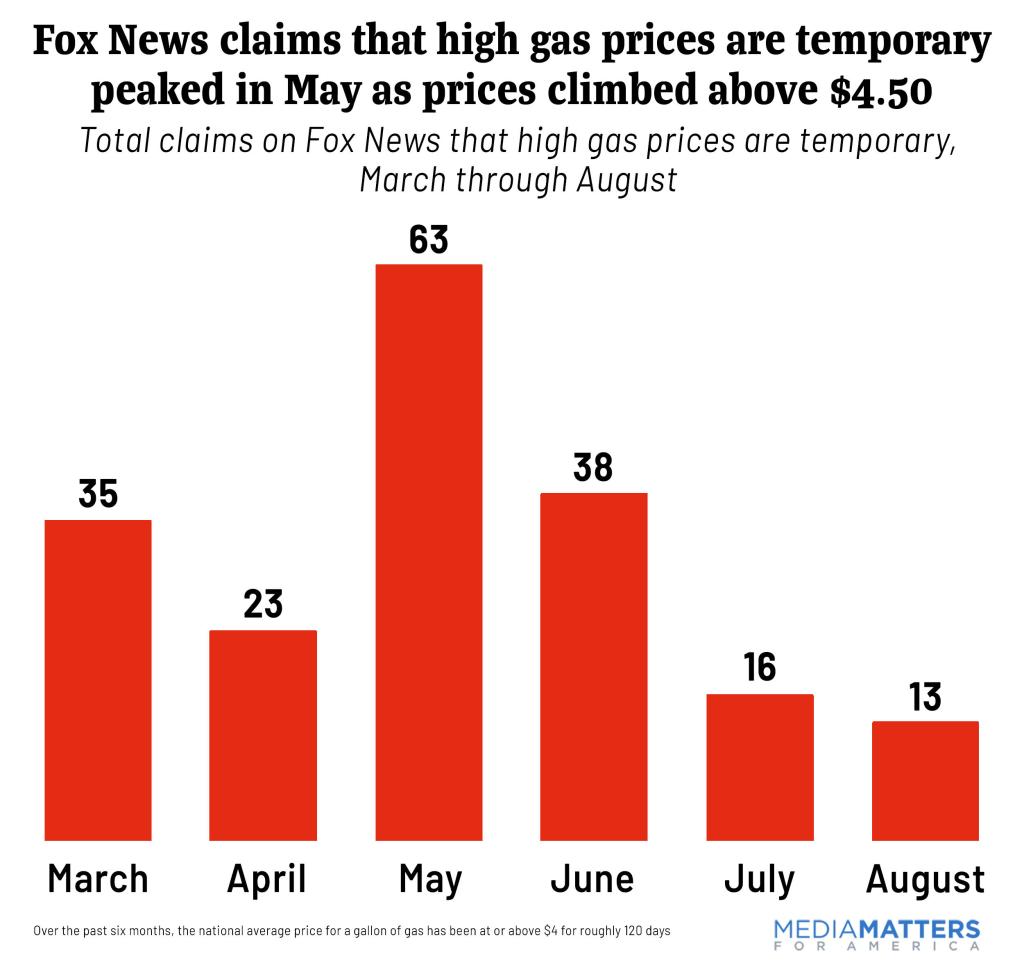
Of this latter claim, Media Matters found that Fox hosts and guests repeated it at least 188 times from the beginning of the war through August, with the claim peaking in May when gas prices topped over $4.50 per gallon.
Excluded from the study were the multitude of times Fox figures directly quoted or attributed the claim about gas prices’ temporariness to Trump or other officials from his administration. Taken all together, the network presented a clear narrative that a return to pre-war gas prices was imminent, even as the timeframe for when viewers could expect that return moved ever further away and as experts repeatedly cautioned about the long-term impact of the conflict on energy prices.
-
Claims peaked in May when gas prices were at their highest and started to decline in subsequent months, with just 13 claims in August
-
Of the 188 claims that high gas prices were temporary, 63 were made in May when gas prices topped more than $4.50 a gallon. Their frequency then began to decline, with 38 claims in June, followed by just 16 in July and 13 in August as network figures seemed increasingly to try to normalize the higher cost.
For example, on the August 29 edition of Fox & Friends Weekend, host Charlie Hurt said, “We're all complaining because we're paying $4 a gallon for gasoline. It's not nearly what it could be.” On August 16, Fox & Friends Weekend host Rachel Campos-Duffy seemingly applauded Trump for “keeping” gas prices at $4: “I have to admit that even though the prices are higher, it's not as high as one would expect given the Straits of Hormuz and this war and the situation there. So how is the president keeping the price at $4?” Fox Business host Jackie DeAnglis responded by suggesting that $80 per barrel oil prices were “the sweet spot where the president wants to keep it.” On August 8, Fox host Mark Levin detailed the suffering of the “Greatest Generation” during World War II to mock young people for “whining about a dollar of gasoline.”
Notably, this is the “first time ever” that “the national average in August has been above $4 per gallon every day,” according to AAA.
-
-
Some claims have included predictions of an exact timeframe for when prices would drop. Other claims asserted that prices would plunge immediately following a ceasefire agreement, the reopening of the Strait of Hormuz, or U.S. victory over Iran. But even as these conditions have supposedly been approached or met, according to Trump and some on Fox (the president has repeatedly declared the strait open and claimed victory over Iran), gas prices have remained elevated.
At the start of the conflict, the national average price for a gallon of gas was $2.98. Prices peaked in late May at $4.56 per gallon, and reached their lowest point since the war began on July 7, when the national average dropped to $3.79 following the signing of a “memorandum of understanding” between the two countries. As the deal began to fall apart, prices ticked back up, and on July 20, they again crossed the $4 threshold, where they have hovered ever since. On September 8, the price of oil reached nearly $100 a barrel, which could drive U.S. fuel costs even higher.
-
Over the past six months, Fox figures have repeatedly moved the goalpost on when prices would return to pre-war levels
-
In March, Fox host Ainsley Earhardt said that she would “pay a little bit more for gas … for the next few weeks.” Host Jesse Watters, meanwhile, noted that “you can’t keep prices high too long, especially going into Memorial Day,” and predicted that “when the operation winds down,” Trump would be riding the drop in prices “through the summer.”
In April, Fox host Kayleigh McEnany assured viewers that “President Trump can and will bring that [$4 gas] down when he wraps this up. He says two to three weeks is what he is asking for.” Fox Business’ Larry Kudlow claimed on America Reports, “This is a temporary thing. … How fast does it come down? I don't know. But it will come down quite a bit this spring and summer as this develops." Conservative economist and frequent Fox guest Stephen Moore said, “In a matter of weeks, we're going to have the Straits of Hormuz open and then … we’re going to see the gas price and the oil price go right back down, in my opinion, to where it was before.” On America Reports, Fox anchor Sandra Smith reported that “right now, it looks like gas prices are heading lower and the treasury secretary even indicated he thinks we could see $3 [per gallon] between June and August this year.” Fox Business contributor Phil Flynn agreed and claimed that the Trump administration “did everything it took to keep prices under control,” adding, “We are seeing the benefit of that at the pump. Confidence that they know what they're doing is keeping those prices under wraps.”
In June, Fox Business’ Charles Payne said on America Reports, “I think where gasoline prices were about two or three weeks ago, that's going to be our peak. We’ll start to come down pretty rapidly … certainly people will start to feel it and see it during the so-called summer driving season.” Later that month he predicted, “Gasoline, I think, you know, well under $3.50 by the election — maybe even lower.”
In July, Payne told Fox & Friends that we could get close to Trump’s goal of $2.50 per gallon gas “before the end of the year” — a figure notably lower than before the war started. On July 20, the national average price for a gallon of gas returned to $4. Over the next several days, Fox News barely covered the milestone.
By mid-August, Payne was still forecasting “significantly” lower prices “by the end of the year.”
-
Fox figures predicted that prices would come down when certain conditions were met, including when the Strait of Hormuz was reopened, a ceasefire was reached, or when the conflict was resolved
-
Even as the Trump administration has repeatedly insisted that the Strait of Hormuz is open, gas prices have remained elevated. Just days after Trump's latest declaration on August 27, the U.S. and Iran once again traded attacks that paralyzed the shipping route.
Even if the strait does reopen, experts have said since the early days of the conflict that it could take months for prices to stabilize and even longer to return to pre-war levels. GasBuddy’s head of petroleum analysis, Patrick De Haan, told FactCheck in May that “for pre-war prices to show up, it could take beyond a year.”
Nevertheless, Fox figures have consistently argued that the opposite is true. Fox Business’ Taylor Riggs claimed on Fox & Friends that “this is temporary. The minute that this war stops and the Strait of Hormuz opens … gas prices will fall.” Stephen Moore claimed, “When we get the Strait of Hormuz open, I think you could see the gas price fall very rapidly to about $3 a gallon.” Phil Flynn also claimed that, after the strait opens, “you’ll see a huge drop in oil and gasoline prices.”
Fox figures have also repeatedly suggested that gas prices would drop to pre-war levels or lower at the conclusion of the war, echoing Trump’s claims while dismissing experts who have warned that prices could stay elevated for months to come even after a resolution.
Larry Kudlow claimed in March that “when this war ends, and the war is close to getting over” the price of gas will “move back toward two and a half bucks, where it was before.” In response to Trump’s March 31 claim that “all I have to do is leave Iran” and gas prices will “come tumbling down,” Fox Business anchor Cheryl Casone declared, “I agree with the president.”
On One Nation with Brian Kilmeade in early April, right-wing commentator and podcast host Danielle Pletka argued, “This is not the Iraq War. We’re going in, we have a finite mission, and then we’ll be out and there will be no reason why gas prices will not settle down again very quickly.”
As the Trump administration told Axios over an approximately month-long period that a deal with Iran was imminent, Fox figures argued that whatever that deal entailed, lower gas prices would be the result. Fox contributor Lou Basenese said on America Reports in May that “prices, to his [Trump’s] point, are absolutely going to come crashing back down once we get to a resolution.” On The Big Weekend Show, host Tomi Lahren said, “We got good news today that we are on the precipice, we are on the cusp, of a peace deal, so I do expect gas prices to tumble.”
After a ceasefire deal was reached in June, Moore told America’s Newsroom anchor Dana Perino: “I’m going to make a prediction that we'll see gas prices at below $3.50 nationally pretty quickly.” But after the MOU was signed on June 17, prices declined only slightly. In fact, when prices did not plummet, Trump accused first Big Oil and then gas station owners of price gouging. As prices began to climb again in July in response to the deal falling apart, Wall Street Journal cautioned that “even if there’s another ceasefire that allows oil to again flow, gasoline and diesel prices are likely to stay higher for longer.”
Six months into the conflict, Fox’s failed predictions and wishcasting reveal many Fox pundits as nothing more than unreliable narrators on the economic impacts of Trump’s war of choice, which has so far cost Americans nearly $100 billion more for gasoline and diesel alone and “roughly $1,000 per household in higher fuel, food and other expenses since the start of the conflict.”
-
Methodology
-
Media Matters searched transcripts in the SnapStream and Kinetiq video databases for all original programming on Fox News Channel for the terms “gas,” “gasoline,” “fuel,” “pump,” “diesel,” “tank,” or “gallon” within close proximity of any of the terms “temporary,” “blip,” “brief,” “limit,” “cost,” “price,” “down,” “less,” or “tumble” or any variations of any of the terms “decrease,” “drop,” “fall,” “low,” or “decline” from February 28, 2026, when the U.S. and Israel jointly launched a war against Iran, through August 31, 2026.
We included claims, which we defined as instances of uninterrupted blocks of speech by a single speaker who argued that rising gas prices would be temporary. For host monologues, headline reports, and correspondent reports, we considered a claim to be the block of speech between read quotes and played clips. We did not consider the speech within read quotes or played clips unless a speaker in the segment positively affirmed said speech either directly before or after the quote was read or the clip was played.
We considered a claim to have argued that high gas prices would be temporary if the speaker referred to surging gas prices as temporary or short-term; argued that gas prices would go down when the conflict is resolved, the Strait of Hormuz is opened, a deal is reached, or there is a cease-fire; or predicted a specific near-term time period when prices would return to near pre-war figures or lower.